RPG Tsukuru 2, in English#
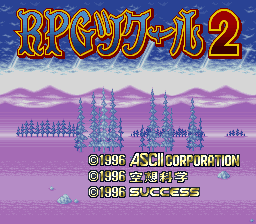
RPG Tsukuru 2 (RPGツクール2) is a Super Famicom cartridge for making role-playing games without programming. ASCII published it in January 1996, and Kuusou Kagaku (空想科学) developed it. It was never released outside Japan, and the program is in Japanese only. This guide explains in English how to make a game with it and how to play one, and describes how the program works inside.
You make a game in ten editors: heroes, items, magic and enemies, a walkable world map with up to 128 maps for towns and dungeons, and events that tell the story. Then you play it on the same cartridge. The finished game plays like a Dragon Quest of its time: a command window on the field, front-view battles, a land, a sea and an air vehicle, and an ending that rolls your own credits. The cartridge keeps one game of your own, besides the sample game in its ROM. A Turbo File Twin or a Satellaview memory pack holds more.
RT2 sits between two other games by the same studio. It shares its core code with RPG Tsukuru: Super Dante on the Super Famicom, and it led to RPG Tsukuru 3 on the PlayStation, whose English version is the American RPG Maker. RT3 kept RT2's text code, event model, database and test-play tools. Compared with RPG Tsukuru 3 shows what moved.
About this guide#
This is an original English guide, not a translation. It was written from a preservation project's study of the program itself. The project read the cartridge's code and decoded every format a game is made of: the save, text, events, maps, graphics, battle, sound and storage. Its findings were checked in the Mesen emulator, and the battle and the screens again in a second emulator, bsnes, which agreed. How it works describes the inside, and Behind the scenes describes the study.
The game came with a manual, and an official guidebook followed in February 1996. The guide doesn't copy either, but it cites them: a badge like Manual pp. 28–33 or Guidebook p. 132 points to the printed page that covers the same ground. Where the study found a book to be wrong, the guide gives the right answer in a box like this one:
Other boxes compare RT2 with RPG Tsukuru 3 and RPG Maker, give design tips, or describe a bug and how to get round it.
The pictures and sounds#
- Screenshots were taken in bsnes by a script, from power-on, with the cartridge's factory save: the sample game loaded in the editor. They can be taken again and come out the same every time. They show the sample game, except on the two pages about the second-hand cartridges' games, which were taken the same way from copies of those cartridges' saves. Some screens have numbered labels, with an English key underneath.
- The graphics catalogue (characters, enemies, battle backgrounds, magic animations, vehicles, map parts, fonts) was drawn straight from the ROM by the project's tools.
- The music and sound effects were played by the game's own sound driver in bsnes and recorded, numbered as the editors number them.
The program is Japanese only, so every screen appears as the game draws it. The text gives each label in English with the Japanese beside it the first time, for example Edit エディット. The glossary collects them all.
The chapters#
Start here#
Making a game#
Resources#
Reference#
What you need#
- The cartridge: RPG Tsukuru 2, SHVC-ZR2J, with its battery-backed save. It works on a Super Famicom or in an emulator that runs Super Famicom games.
- A second-hand cartridge's save is fragile. Copy it with a cartridge reader before you switch the cartridge on for the first time. If the save fails the check RT2 makes at power-on, RT2 erases it without asking (Getting started).
- For more than one game: a Turbo File Twin set to STF holds two, and an 8-megabit Satellaview memory pack holds eight. Both are optional. In emulation, MesenCE has the Twin and Mesen has the memory pack.
- The books are optional too. The guide cites the manual and the official guidebook (Aspect, 1996) for readers who own them.
Fan-made reference material, one of the Eschaton Games Tsukuru guides. Not affiliated with the publishers of the titles it covers.