Covers Manual pp. 74–79 Manual pp. 94–96.
Playing a game#
This chapter is the player's side of an RT2 game: what the screen shows and what each command does. The same rules apply to the sample game, to your own game and to a test run of it. How battles work gives the battle's rules in full. Events shows how a maker builds the shops, inns, chests and save points a player meets here.
Starting#
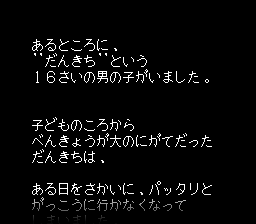
From the top menu, Game ゲーム → Start 初めから begins a new game, and Continue 続きから resumes a play save (Getting started). A new game puts the party where the maker set it, usually on the field. Some games begin with an event first: the sample game opens with a caption on a black screen.
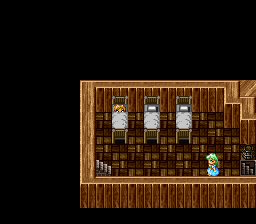
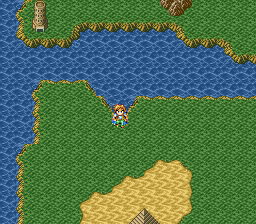
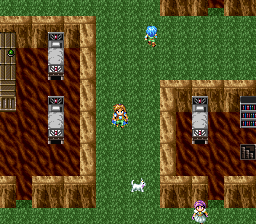
The party walks as a line: the leader first, the others following in its steps. The leader moves one cell in 8 frames, a little under 8 cells a second. A map has edges. The field wraps around: walk off one side and you come in at the other.
The command window#
Press A on the field to open the command window. The gold is shown at the top right, and a box at the bottom right shows each member's HP, MP and level (H, M, L). The layout is Dragon Quest's.
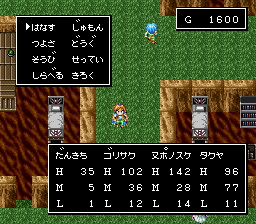 12345678910
- 1 Talk はなす only the cell directly ahead of the leader; not on a vehicle
- 2 Spells じゅもん in the field only healing, teleport, cure and lift curse; revive is battle-only
- 3 Status つよさ level, HP, MP, equipment, attack, defence, the five stats and experience
- 4 Items どうぐ the bag, by kind; there is no discard
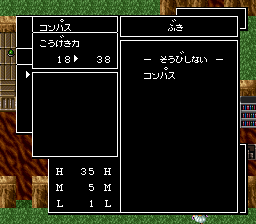
- 5 Equip そうび five slots; unequipping (そうびしない) loses the item
- 6 Settings せってい order, cursor speed, battle messages, sound, window colour
- 7 Search しらべる the cell underfoot, then the one ahead
- 8 Record きろく only on the field and on foot (or at an event's save point)
- 9 Gold G the party's gold, up to 999,999
- 10 Party だんきち ゴリサク ヌポノスケ タクヤ up to four members, each with HP, MP and level
| Command | Japanese | What it does |
|---|---|---|
| Talk | はなす | Speaks to whoever stands on the cell in front of the leader. Not from a vehicle. X does the same from the field |
| Spells | じゅもん | Casts a spell a hero has learned. Outside battle only healing, curing, lifting a curse and teleport work |
| Status | つよさ | A hero's level, HP, MP, ailments, equipment, attack, defence, the five stats and experience |
| Items | どうぐ | Uses an item from the bag. Nothing can be thrown away |
| Equip | そうび | Changes a hero's weapon, armour, shield, helmet and ring |
| Settings | せってい | Party order, cursor and message speed, sound, the window colour; in test play, the test tools too |
| Search | しらべる | Looks at the cell underfoot, then the one in front |
| Record | きろく | Saves the game to one of three slots: only on the field and on foot |
Talk and Search#
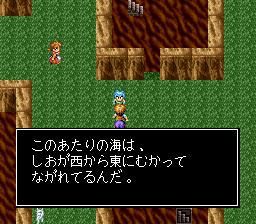
Talk はなす reaches only the cell directly in front of the leader. The person there turns to face the party and speaks. If no one stands there, the game says so. X talks without opening the window Manual pp. 74–75.
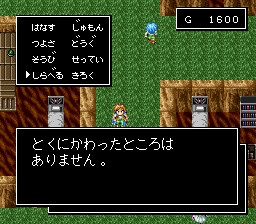
Search しらべる looks first at the cell the leader stands on, then at the one in front. Whatever a maker hid for searching is found this way. With nothing there, the answer is 「とくにかわったところはありません」: nothing unusual here.
Status and Equip#
Status つよさ shows one hero in full: level, HP and MP, poison or paralysis, the five pieces of equipment, attack and defence, maximum HP and MP, the five stats (strength, vitality, wisdom, speed, luck) and experience. How the stats grow and what they feed is in the database.
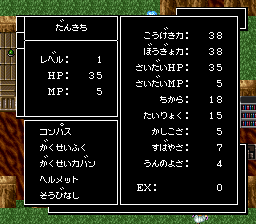 12345678
- 1 Hero だんきち the hero picked from the party list
- 2 Level, HP, MP レベル HP MP current HP and MP; a level-up does not refill them
- 3 Equipment コンパス がくせいふく がくせいカバン ヘルメット そうびなし weapon, armour, shield, helmet, ring; そうびなし is an empty slot
- 4 Attack こうげき力 strength + the weapon's power
- 5 Defence ぼうぎょ力 vitality + armour + shield + helmet
- 6 Max HP, max MP さいだいHP さいだいMP max HP = vitality + 20; max MP = wisdom
- 7 Stats ちから たいりょく かしこさ すばやさ うんのよさ strength, vitality, wisdom, agility, luck: each level adds the hero's gains
- 8 Experience EX the next level at 10, 25, 47, 80 … points
Equip そうび goes through the five slots in turn: weapon, armour, shield, helmet, ring. For each slot it lists the item worn and then the bag's items of that kind the hero is allowed to wear. Equipping takes the item out of the bag, and the one it replaces goes back in.
- A cursed item has a skull beside it. Putting one on says 「呪われてしまった!」 (cursed!), and it can't be taken off. A spell that lifts curses removes it, but the item is lost.
- A paralysed hero can't change equipment.
Items#
Items どうぐ lists the bag. It holds up to 127 kinds of item, up to 99 of each, and nothing can be thrown away. What an item does depends on its kind:
- Healing items, antidotes, paralysis cures and cure-alls ask for a target.
- An item that casts a spell works like the spell in the field, with no MP spent.
- The map shows the whole field with a blinking mark at the party. Press B to close it. It doesn't work inside a map.
- Calling a vehicle puts the land, sea or air vehicle on the cell in front of the party. It is refused inside a map, on a vehicle, with someone in the way, or where that vehicle can't stand (a ship on grass).
- A key opens a door event of its own letter (A to D) in front of the party. Any other key, or no door, gives 「ここでは使えません」: it can't be used here.
- Equipment can't be used.
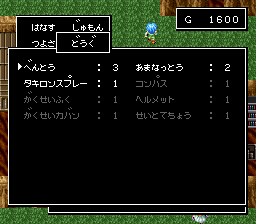
Each item has a chance of being used up, which the maker sets. Most consumables are used up every time. One with a lower chance may survive and be used again.
Spells#
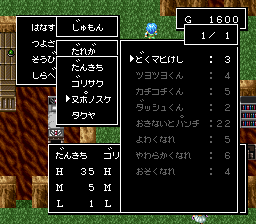
Spells じゅもん lists a hero's spells in the order of the levels they are learned at. Outside battle only five kinds of spell work: heal one, heal all, cure poison and paralysis, lift a curse, and teleport. Revive is battle-only, and so are attacks. A paralysed hero can't cast.
Teleport takes the party to a town or dungeon it has entered before from the field. The list shows the destination maps' names. It doesn't work on a vehicle or inside a map. Before the party has entered anywhere, it answers 「まだどこへも行っていません」: you haven't been anywhere yet.
Settings#
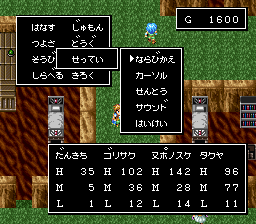
Settings せってい holds the player's preferences, saved with each play save. Manual pp. 76–77
| Setting | Japanese | Choices |
|---|---|---|
| Order | ならびかえ | The order the party walks and fights in (two or more members) |
| Cursor | カーソル | The menu cursor's speed, 1–5 |
| Battle | せんとう | How fast battle messages go, 1–5 |
| Sound | サウンド | Stereo or mono |
| Window colour | はいけい | Black, red, green, yellow, blue, purple, light blue or white |
Saving#
Record きろく saves the game to one of three slots. It works only on the field, and only on foot, which the manual doesn't say Manual pp. 76–77. On a vehicle, or anywhere inside a map, it answers 「ここではきろくできません」: you can't record here. Inside a map the only way to save is a save point that the maker placed as an event. The sample game's save points are cats.
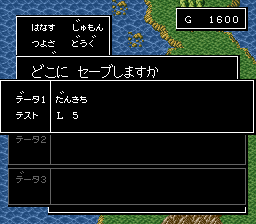
The three slots are shared by the user game, test play and the sample game, and each is tagged with which one it is. A save keeps the heroes and the party, gold, bag, switches and settings, the vehicles' places, and the places visited for teleport. Game over and resetting keep nothing: play since the last save is lost.
Towns, shops and inns#
Shops, inns and save points are events: a maker puts a person behind a counter and gives them the command. So their windows are the same in every game.
A shop おみせ sells up to eight items. Its menu is Buy かいにきた, Sell うりにきた and Leave やめる.
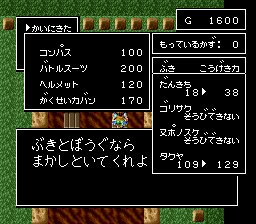 12345678
- 1 Buy かいにきた each A buys one: no quantity, no confirmation
- 2 Stock コンパス バトルスーツ ヘルメット がくせいカバン up to 8 items, with their prices
- 3 Held もっているかず how many the bag holds; at 99 the line greys out
- 4 Slot and stat ぶき こうげき力 the stat this kind of item changes
- 5 Can equip だんきち 18▶38 attack, defence or speed with the item, worked out on a copy of the record
- 6 Cannot equip そうびできない a hero this item is not allowed for
- 7 Gold G too little gold: nothing happens, with no message
- 8 Shopkeeper ぶきとぼうぐなら まかしといてくれよ the event's message before the shop command (2C)
- When you buy, the shop shows for each hero the attack, defence and speed the item would give, or 「そうびできない」 if they can't wear it.
- Each A buys one. There is no quantity and no "are you sure". An item already held 99 times greys out. With too little gold nothing happens, and there is no message.
- Selling pays half the price. An item the maker marked as unsellable shows 「うれない」.
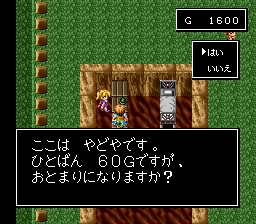
An inn やどや names its price for a night. Staying plays a short tune and restores HP and MP, but not poison or paralysis: those need an item, a spell or a healer's event. With too little gold the innkeeper says so.
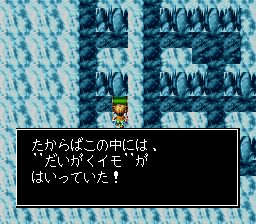
Chests are events too: an object with a chest graphic that gives an item and changes to an open chest. Whether a chest stays empty after it is opened is up to its maker (Events).
Poison and damaging floors#
Poison takes 1 HP from each poisoned member at every step, with a flash, but never takes HP below 1 on the field. In battle it is different: 2 HP each turn, and it can kill. An antidote, a cure-all, a curing spell or an event cures it; an inn doesn't.
Some ground hurts in the same way, 1 HP a step, on the field only. Judging by the field's terrain types, swamps are the hurting ground.
Vehicles and the air view#
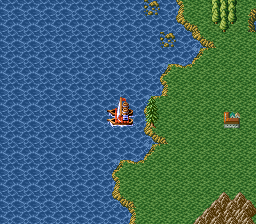
A game can have up to three vehicles: one for land, one for the sea and one for the air. What a vehicle does depends on its slot, not its look. Its graphic can be any of the seven: raft, sailing ship, hovercraft, horse, balloon, airship or dragon. Each vehicle waits where it was left. Walk onto a vehicle to board it: the party gathers into it and its own music plays.


The seven vehicle graphics.
| Vehicle | Boarding and leaving | Where it goes | Battles |
|---|---|---|---|
| Land | Walk onto it; A to get off where the ground allows | As on foot, at the same speed | None, and no poison or damaging floors on the way |
| Sea | Walk onto it; step onto walkable land to get off | Sea and wide rivers, twice walking speed | Sea enemies, where the screen has any |
| Air | Walk onto it; A to land | Over everything, twice walking speed, in the tilted view; lands only on grassland or snowfield | None |
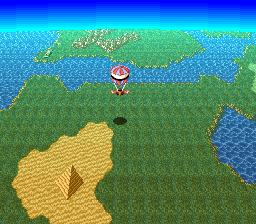
In the air the field tilts into perspective under a sky, in the Super Famicom's Mode 7, as in the opening demo. The air vehicle crosses mountains and sea, but it can land only on grassland or snowfield. Elsewhere A doesn't land it.
At sea, battles use the sea enemies of the screen the ship is on. A lake in an area with only land enemies is safe. Once the party is ashore, land enemies return. The land vehicle meets nothing at all.
Battles#
Random battles happen on foot on the field and in maps, and at sea, step by step, at the rate the maker set for each screen. A few steps after the last battle are always free. Events can also start a battle, usually with a boss, and an event battle can't be fled.
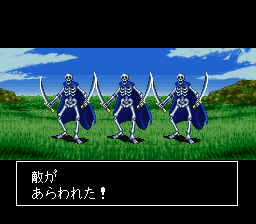
The battle is seen from the front: the enemies against a background chosen by the terrain or by the map, with the party's names, HP and MP in windows. A hero in blue has an ailment (poison, paralysis, sleep, confusion). A hero in red has 0 HP and is out of the fight, but not lost: after the battle the hero is back with 1 HP Manual pp. 78–79.
Commands#
Each round opens with a menu for the party:
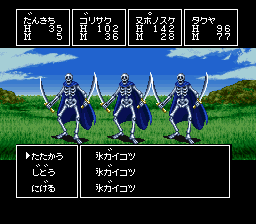 1234567
- 1 Command menu たたかう じどう にげる chosen once a round, after the escape roll
- 2 Fight たたかう each hero then picks こうげき, ぼうぎょ, じゅもん or どうぐ
- 3 Auto じどう every hero chooses by itself, for this round only
- 4 Run にげる the escape roll, made every round, compares the two sides' speeds; event battles can't be fled
- 5 Enemies 氷ガイコツ the group: at most four, chosen from the area's enemy mask
- 6 Party だんきち ゴリサク ヌポノスケ タクヤ HP and MP of each hero
- 7 Enemy graphics 氷ガイコツ centred and standing on the bottom row; the background follows the terrain (grassland here)
| Command | Japanese | What it does |
|---|---|---|
| Fight | たたかう | Give each hero an order (below) |
| Auto | じどう | The heroes choose for themselves, this round only |
| Escape | にげる | Try to run. Speed decides the odds; a fight started by an event can't be fled |
| Attack | こうげき | Strike one enemy with the weapon, or bare-handed |
| Spells | じゅもん | Cast a learned spell on a target |
| Guard | ぼうぎょ | Halve the physical damage the hero takes this round |
| Items | どうぐ | Use an item from the bag |
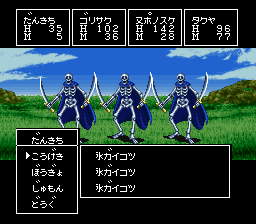
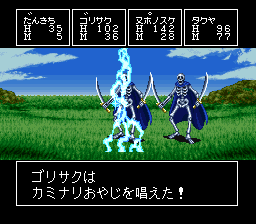
Then everyone acts, fastest first: the order is fixed by speed, with ties going to the party. Damage is (attack − defence) ÷ 2, with no random spread. Criticals are 1 in 16. The details, and how enemies and Auto choose, are in How battles work.
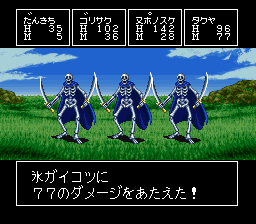
- The surprise round. About one random battle in 32 opens with 「敵が いきなり おそってきた!」, the enemy attacks suddenly: the enemies get a free first round.
- Escape is decided by a roll at the start of the round. It always works if the party's slowest member is at least as fast as the fastest enemy, and becomes less likely the faster the enemies are. A successful escape says 「〜達は逃げ出した!」 (the party ran away!).
- Items and spells used in battle have the full set of effects: attack spells, revive, raising and lowering stats.
After a battle#
When the last enemy falls, the party wins the enemies' gold and experience. Every hero still standing gets the whole experience total, not a share. Heroes at 0 HP get none, and come back with 1 HP.
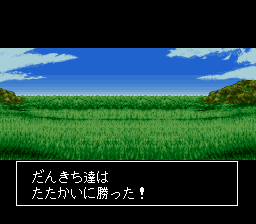
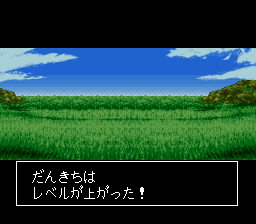
- A level-up is announced hero by hero, with the spells learned, and waits for A. Several levels can come at once. A level-up doesn't refill HP or MP.
- A chest may follow. Only the last enemy killed decides whether one appears and what it holds, with the party's luck adding a little to the chance.
- Sleep, confusion and the like end with the battle. Poison and paralysis stay.
The experience needed for each level climbs by about half again each time up to level 20, then by a flat 32,768 a level, to level 99 Manual p. 94. How battles work gives the table.
Game over#
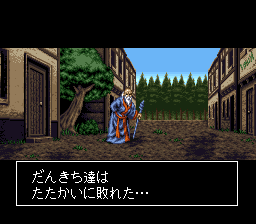
If the whole party falls, the screen says the party lost 「〜達は たたかいに敗れた…」 and the game returns to the top menu. Nothing is saved and nothing is kept: the game picks up again only from a play save.
The ending#
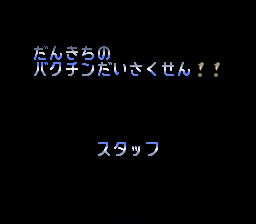
A game ends when an event gives the ending command. The screen fades, the maker's chosen music plays, and one staff roll runs, the game's own credits woven into RT2's: it opens with the game's title and its scenario design and map design lines from Title Settings, then RT2's own staff follow, and the game's special thanks line joins RT2's own special thanks, just before the supervisors. Then come the copyright cards (ASCII, 空想科学 and SUCCESS), and the program returns to the opening demo. A game that never reaches an ending command simply has no end.
Test play#
Game → Start → User Game Test ユーザーゲームテスト plays your game with tools for checking it. Manual pp. 74–75
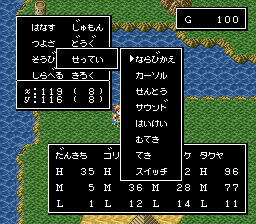 123456789
- 1 Settings せってい test play's own list: the usual five and three more
- 2 Party order ならびかえ reorders the party
- 3 Cursor, messages, sound カーソル せんとう サウンド cursor speed 1-5, battle message speed 1-5, mono or stereo
- 4 Window colour はいけい eight colours, an HDMA gradient
- 5 Invincible むてき heroes take no damage and their attacks do 9,999
- 6 Monsters てき off: no random encounter is rolled
- 7 Switches スイッチ the switch editor (ゲームスイッチの してい)
- 8 Position X: Y: the leader's cell and screen, shown only in test play
- 9 Gold G the party's gold
| Tool | Japanese | What it does |
|---|---|---|
| Invincible | むてき | The heroes take no damage, and each hero's attack does 9,999 |
| Monsters | てき | Random battles on or off (on when a test starts); event battles still happen |
| Switches | スイッチ | Turns any of the 240 switches on or off, 20 to a row |
| Position | The party's place, shown under the command window: column and row, with the screen in brackets | |
| Through walls | Hold B while walking to pass anything |
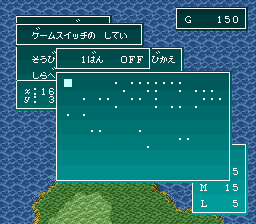
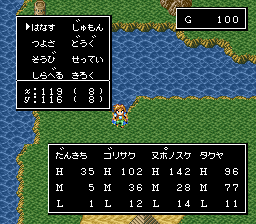
A test run is saved like any game, tagged Test, and its play save remembers Invincible and Monsters. Continuing it later restores them. Test play reads the game from the save, so save each editor before a run (Getting started).
Fan-made reference material, one of the Eschaton Games Tsukuru guides. Not affiliated with the publishers of the titles it covers.