Compared with RPG Tsukuru 3#
This page is for a reader who knows RPG Tsukuru 3 (PlayStation, 1997) or its American localisation, RPG Maker for the PlayStation. RT3 and RPG Maker are one program: RPG Maker is RT3 translated, with the same editors, the same event commands and the same battle engine. Everything said here about RT3 holds for RPG Maker unless the text says otherwise.
RPG Tsukuru 2 is RT3's direct ancestor. Both were developed by the same studio, Kuusou Kagaku (Behind the scenes). RT3 kept RT2's character code, its event model, its kinds of database record, its movement types, its split between the world map and the other maps, and its test-play tools. It rebuilt all of them on the PlayStation with more of everything, and dropped what the Super Famicom's limits had shaped: the packed battery save, one command for every direction, a script machine for the menus. It also dropped the walkable world map and its vehicles.
Both programs have been taken apart to the byte, RT2 in the study behind this guide and RT3 and RPG Maker in a sister study, so the comparisons below are between what the two programs actually do, not what their manuals say.
At a glance#
| Area | RPG Tsukuru 2 (SFC, 1996) | RPG Tsukuru 3 / RPG Maker (PS1) | Kept, added, dropped |
|---|---|---|---|
| Text | One byte a character: kana, digits, capitals and 96 kanji; a 16-pixel proportional font and two 8 × 8 fonts | RT2's one-byte code, shifted to make room for Shift-JIS; every common kanji (JIS level 1) in a 12 × 11 font | Kept the code, added full kanji, dropped the 8 × 8 fonts |
| Saves | One 64 KB battery image, uncompressed, a checksum per section; a bad checksum erases everything | System Data and Scenario Data, compressed, as memory-card files | Kept what the records hold; added compression and the split |
| Database | 12 heroes, 127 items in 15 kinds, 64 spells with 20 effects, 96 enemies; no jobs | 16 characters, 16 jobs, 250 items in 11 kinds, 230 spells with 36 effects, 250 monsters | Kept growth per level; added jobs and about twice the counts |
| Events | 4 pages chosen from page 4 down; conditions on an item, heroes, a switch, gold; 40 commands; 240 switches; no variables | The same page model with more pages; 27 commands; switches and gold usable as counters; Take Over | Kept the page model and all but two commands; added much |
| Maps | 16-pixel chips → 64-pixel parts → screens from a shared pool of 300; a map up to 4 × 4 screens | Cells of one 24-pixel tile each, plus an object layer; dungeons a fixed 65 × 65 cells | Kept the two layers and the attribute per cell; dropped the packing |
| World map and vehicles | The field is walked on and wraps round; land, sea and air vehicles; the air view in Mode 7 | A flat 64 × 64 map crossed town to town with a cursor; the Boat and Blimp are items | Dropped the walked field and the vehicles |
| Battle | Fixed speed order, no misses, no variance; enemies choose with equal odds | Order re-rolled each action, misses, ± 10 % damage, weighted patterns | Kept the shape and the damage formula; added chance everywhere |
| Movement | 8 movement types, each a small move script | The same 8 types in the same order | Kept, with new timing |
| Sound | Its own sound driver; 30 songs, 65 effects; the SFC Kanadeeru's songs through a memory pack | Sony's sound library; Kanadeeru 2's songs imported from a card | Only the idea of the music tool's songs as BGM |
| Storage | The battery; a Turbo File Twin; a Satellaview memory pack | PS1 memory cards | Only the idea of a game moved whole with its saves |
| Graphics import | No drawing editor; a memory pack's graphics file was planned | Imports from Anime Maker | Added |
| Menus and windows | Small programs for one script machine | Native code | Dropped the script machine |
| Test play | Invincible, monsters on or off, a switch editor, walking through walls, a position readout | Invincible, Battle on or off, a 500-switch editor, a Game System page | Kept three tools; dropped walking through walls |
| Sample game | だんきちのバクチンだいさくせん!!, a school comedy | ゴブリくんの冒険 (Gobli) | Nothing carried over |
Area by area#
Text#
RT2 stores text one byte a character in a code of its own: hiragana and katakana, digits, capital letters, punctuation, and 96 kanji a user can type (three kanji pages on the keyboard), with more kanji for the program's own menus (How it works). Menus and messages are drawn in a 16-pixel proportional font; the battle and the small text of the menus use two 8 × 8 fonts.
RT3 kept the code. 139 of RT3's 200 one-byte codes are RT2's at the same value: the digits, the capitals and everything from エ to the end, the voiced kana in RT2's order. The other 58, the hiragana and a few katakana, are RT2's in the same order moved down, which frees the range the PlayStation's Shift-JIS uses for two-byte characters. So RT3 added every common kanji (a 12 × 11 font), while a name or message from RT2 would convert to RT3 by a fixed table. RT3 dropped the 8 × 8 fonts; a dead 8 × 8 mode is still in its code.
Saves#
RT2's whole project is one 64 KB battery image: a header, three play saves, the database in fixed tables, the maps and one shared space for events, with a checksum for each section. Any wrong checksum at power-on erases the whole project (Behind the scenes). Nothing is compressed, and small values are packed into the spare bits of others to save room.
RT3 splits a game into System Data (the database and maps) and Scenario Data (the events), compresses each, and keeps them as memory-card files; a scenario can name the next one, so a long game is several scenarios in a chain. What the records hold carried over: item kinds, who can equip what, which spells an enemy casts, an enemy's treasure and its chance.
Database#
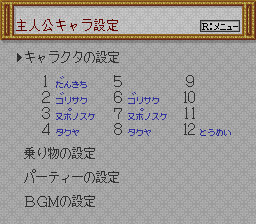
| RT2 | RT3 / RPG Maker | |
|---|---|---|
| Heroes | 12 | 16 characters |
| Jobs | none | 16 (RT3's 職業; RPG Maker's Skills) |
| Items | 127, in 15 kinds | 250, in 11 kinds |
| Spells | 64, each one of 20 effects | 230, with 36 effects |
| Enemies | 96: 32 field, 32 dungeon, 32 event | 250 monsters |
| Stats | Five gains a level: strength, vitality, wisdom, speed, luck | Seven stats |
A stat in RT2 is a base plus the level times the hero's gain (The database). RT3 kept that shape and added a second growth term from the job, so a stat is the character's and the job's growth times the level, plus a base. The item kinds were rearranged: RT2 has 15 (none, weapon, armour, shield, helmet, ring, HP and MP recovery, antidote, paralysis cure, all-cure, magic, map, call a vehicle, key), RT3 has 11, among them Transport, the vehicles as items, and Food. RT3's monsters choose from an action pattern of up to eight entries, where an RT2 enemy has a set of battle methods and spells and picks among them with equal odds.
Events#
RT2's event is the model RT3's grew from. Each event has up to four pages; the game tries page 4, then 3, then 2, and runs the first whose conditions all hold, page 1 being the fallback. A page's conditions are an item, heroes in the party, a switch and an amount of gold (Events). The stored record (its size, place, the mask of pages present, pages highest first with their conditions, choices with no end marker) is the ancestor of RT3's, and so is the interpreter: commands copied to a buffer and run, with commands the runtime inserts itself.
- Kept: every RT2 command but two has an RT3 counterpart (below, Where things moved).
- Dropped: RT2's mosaic and its Vanish command. RT3 has no mosaic, and makes an event disappear with pages and its Ghost setting. RT2's way of spending one command code on each direction, colour and step style (40 commands in the editor are 75 codes) was folded into options: RT3 has 27 commands in 92 codes.
- Added: Take Over, party display, stats, effects, two- and three-way choices and chance branches, the Game System switches and the scenario chain. RT2 has 240 switches and no variables; RT3 has 500 switches and lets switches and gold serve as counters.
Maps#
RT2 builds maps in three levels to save battery memory: 16-pixel chips make 64-pixel parts (each map type has its own set of 256), parts make 256-pixel screens, and screens come from one pool of 300 shared by all 128 maps. A map is a grid of up to 4 × 4 screens and only the screens used cost memory. The world map is built from 184 island parts held in the ROM (Maps).
RT3 dropped the packing and draws a map cell by cell, each cell one 24-pixel tile; a dungeon map is a fixed 65 × 65 cells. It kept the split between the world map and the other maps (RT2 has both in one editor, RT3 in two: Field Edit and Dungeon Edit), a ground layer with an object layer over it, and an attribute byte for each cell. One difference: RT3's object layer is part of the map, while RT2's objects come only from object events.
World map and vehicles#
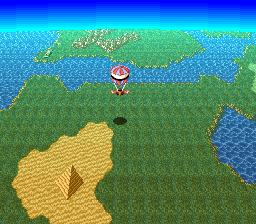
In RT2 the world map is walked on. It wraps round at its edges, has 13 kinds of terrain, and has three vehicles, land, sea and air, each a moving object with its own graphic and start position; the air vehicle shows the world in perspective (Mode 7) and lands on grassland or snowfield (Playing a game).
RT3 dropped all of that. Its world is a flat 64 × 64 map crossed from town to town along paths with a cursor, with no random battles on it. The boat and the airship survive only as items of the Transport kind (RPG Maker's Boat and Blimp).
Battle#
The battle screen is the same in spirit: the enemies seen from the front, the party's commands in a menu. RT3 kept the damage formula, guarding and auto battle, and added chance at every step. RT2's battle has almost none: a fixed order, no misses, no variance (How battles work).
| RPG Tsukuru 2 | RPG Tsukuru 3 / RPG Maker | |
|---|---|---|
| Turn order | Fixed for the round: fastest first, no chance | Re-picked before every action, speed ± a fifth |
| Hitting | Every attack hits | 5 % miss; a hero's luck can change it |
| Damage | (attack − defence) ÷ 2, at least 1; no variance | (attack − guard) ÷ 2 ± 10 % |
| Critical hit | 1 in 16 (1 in 4 for an enemy with the critical method); attack − defence | About 6 % (16 % with Crit UP); damage × 2 |
| Guarding | Halves physical damage this round | Halves physical damage until the guarder's next action |
| Magic | Fixed points; an enemy is hit only if the spell is marked as working on it | Points with variance; immunity, reflection |
| “Misses half its attacks” | The 14th battle method, こうげきを ミスする | A monster setting, Miss 1/2 |
| Enemy choice | Every method and spell it has, equally likely | A weighted pattern of up to 8 actions |
| Auto | A fixed list of priorities, no chance | Party AI with its own rolls |
| Escape | One roll a round, on the two sides' speeds | A roll of 100 against a table; first strikes and ambushes |
| Poison | 2 HP at the poisoned member's turn; can kill | Damage at the end of the turn |
| Treasure | The last enemy killed: its chance plus the party's average luck ÷ 100 | Each monster's own drop rolls |
| Random numbers | The game's own generator, never reseeded after power-on | The PS1 BIOS's generator |
RT2's unnamed-in-the-books fourteenth battle method, こうげきを ミスする (misses attacks), makes half an enemy's attacks and spell targets fail. RT3 turned it into a monster setting, RPG Maker's Miss 1/2.
Movement#
Both programs have the same eight movement types in the same order: stand still, random, back and forth across, back and forth up and down, approach the hero, flee the hero, tread in place, blink (RPG Maker: Don't Move, Random, Right-Left, Up-Down, Close Up, Away, Step Only, Flashing). In both, each moving object runs a small move script chosen by its type. RT3 changed the timing: an RT2 person decides every 80 frames and steps every 78 measured, an RT3 person on a 49-frame cycle with one decision a frame shared among the objects, and RT3 breaks ties at random when approaching.
Sound#
The engines share nothing. RT2 has its own sound driver on the Super Famicom's sound chip, 30 songs and 65 effects on one set of instruments (Music and sound); RT3 plays Sony's sound library, a sequence and a sound bank for each song, with 24 voices. What carried over is an idea: the music maker's songs as a game's music. RT2 plays a memory pack's song file as BGM 31 and up, and the Super Famicom Kanadeeru carries a template for just such a file; RT3 imports Kanadeeru 2's songs from a memory card (RPG Maker cut that).
Storage#
RT2 keeps one user game in the cartridge's battery and moves it whole, with its play saves, to a Turbo File Twin (two games) or a Satellaview memory pack (eight). RT3 saves to PlayStation memory cards through the console's own routines. Nothing is shared but the idea of a game carried to a friend with its saves (Behind the scenes).
Graphics import#
RT2 has no drawing editor. Its Data page can choose a memory pack's graphics file, which could add map part sets, enemy graphics and palettes; such files were to be broadcast for the Satellaview, and none is known to survive. RT3 added a working import path from a companion program, Anime Maker.
Menus and windows#
Every RT2 window, menu, editor screen and the battle's flow is a small program for one script machine in the cartridge's core. RT3 went back to native code: each menu and editor is a task in the program with a table of states. Where the menus meet the events, both hand the work to the event interpreter.
Front end and test play#
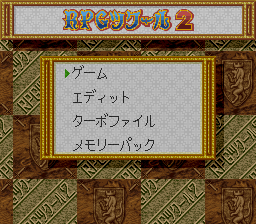
RT2's top menu is Game, Edit, Turbo File, Memory Pack; RT3's is ゲーム / エディット / 戻る (Game, Edit, Return to the launcher), with the memory card under Edit. RT2's sample game is under Game → Start beside the user game and its test, where RT3's GAME menu lists it on its own.
Test play kept its three tools: invincibility, random battles on or off and a switch editor (RT3's for 500 switches, with a Game System page as well). RT2 also lets the party walk through walls while B is held and shows the party's position; RT3 dropped both. Both have a battle test beside the encounter editor: RT2's in Enemy Map Editing's R menu, RT3's in Monster Appearance.
Sample game#
Nothing carried over. RT2's sample, だんきちのバクチンだいさくせん!!, is a school comedy whose lessons are the manual's tutorial (The sample game); RT3's, ゴブリくんの冒険 (RPG Maker's Gobli), is a fantasy with a goblin hero. The link runs the other way: RT2's epilogue advertises RT3, which came out almost two years later.
Hidden content#
No leftover is shared. RT2 has no debug menu and no orphan text; its leftovers are the studio's development tag, a test page in the factory save and two bugs (Behind the scenes). RT3's dead code and development leftovers are its own.
Where things moved#
For an RT3 or RPG Maker user looking for something in RT2: first the menus and editors, then the event commands. RPG Maker's English names are given; RT3's Japanese where it differs from what the names suggest.
| In RPG Maker (RT3) | In RT2 | Notes |
|---|---|---|
| GAME → Continue, Start | Game ゲーム → Continue 続きから, Start 初めから | Three play saves on the cartridge. Playing a game |
| GAME → Sample Game | Game → Start → Sample Game サンプルゲーム | It plays from the ROM, whatever the editor holds. The sample game |
| (the card utility) | Game → Game Data ゲームデータ | Copies and deletes play saves |
| EDIT → Test Play | Game → Start → User Game Test ユーザーゲームテスト | Test play is a way of starting the game, not an Edit entry |
| EDIT → MEMORY CARD | Each editor's R menu → Save; the top menu's Turbo File and Memory Pack | The battery holds one user game; the add-ons hold two or eight more. Behind the scenes |
| EDIT → Load Sample | Edit → Data → load all the sample data; or one editor's R menu → Sample Load | RT2 can load the sample one editor at a time |
| EDIT → Edit Data | Edit エディット: ten entries in one menu | No System and Scenario halves |
| RETURN | — | The cartridge has no launcher to return to |
| Title, Set System Data | Title Settings タイトルの設定 | The title (two lines of 14) and three credit lines whose headings are fixed. No title picture, password or scenario chain |
| Configuration | Config コンフィグ | Editor music, stereo or mono, cursor speed |
| Gameplay Edit (項目エディット) | — | RT2's rules are fixed |
| Parameter Name | — | RT2's words are fixed |
| Magic | Magic Editing 魔法の編集 | 64 spells, each one of 20 effects. The database |
| Item | Item Editing アイテムの編集 | 127 items in 15 kinds. Vehicles aren't items: an item can only call one |
| Main Characters (主人公) | Hero Settings 主人公キャラ設定 → Heroes | 12 heroes; growth per level, start level and equipment, the level each spell is learnt |
| Skill (職業) | — | No jobs: a hero's spells come from the hero's own spell levels |
| — | Hero Settings → Vehicles | Land, sea and air vehicles, their graphics and where they start |
| Event Edit's Start Point | Hero Settings → Party | The starting party, gold, map and position |
| — | Hero Settings → BGM | 11 slots: the field, battle, the three vehicles and each kind of map |
| Field | Map Making マップの作成, the Field row above map 001 | The world, up to 16 × 16 screens of island parts. Maps |
| Dungeon | Map Making, maps 001–128 | Towns, castles and caves alike, up to 4 × 4 screens each |
| Event | Event Making イベントの作成 | Events |
| Monster | Enemy Settings 敵キャラの設定 | 32 field, 32 dungeon and 32 event enemies |
| Monster Appearance (モンスター配置) | Enemy Map Editing 敵マップの編集 | Enemies and a rate for each screen; the R menu's battle test |
Event commands#
RT2's commands in the order of its command picker, with RT3's counterparts. RT2's own names are explained on Events.
| RT2 command | On screen | In RPG Tsukuru 3 / RPG Maker |
|---|---|---|
| Message | ぶんしょうをかく | Display Message (with message types and balloons) |
| Caption | テロップをかく | Display Message, Message 1 (the rising lines) |
| Yes / no | はい/いいえ | YES/NO; also choices of 2 or 3 messages and chance branches (new) |
| Switch on / Switch off | ゲームスイッチオン, オフ | Switch ON / OFF, plus forms for a range of switches (new) |
| Battle | てきとたたかう | Battle till End, Battle End n Turn, with a win/loss branch |
| Wait | ウェイト | Wait (the same tenths of a second) |
| Warp | ばしょいどう | Move Location |
| Item + / Item − | アイテムがふえる, へる | Add Item / Remove Item |
| Experience + | けいけんちがふえる | Increase EXP (RPG Maker waits for the next battle to level up; RT2 levels at once) |
| Inn | やどや | Inn |
| Shop | おみせ | Item Shop, plus skill shops and trades (new) |
| Save point | セーブポイント | Save Point |
| Gold + / Gold − | おかねがふえる, へる | Gold ±, one command |
| BGM | BGMへんこう | Change BGM, plus volume, tempo and reverb (new) |
| Sound | おとをならす | Sound Effect, also with a pitch (new) |
| End event | イベントしゅうりょう | Exit Event |
| Event faces | イベントのむきをかえる | Event Direction |
| Event moves | イベントのいどう | Move Event (the three step styles become its options), Move to Point (new) |
| Event blinks | イベントのてんめつ | Flashing Event |
| Event spins | イベントまわる | Turn Right / Turn Left |
| Event vanishes | イベントきえる | No such command: done with pages and the Ghost setting |
| Hero HP + / −, Hero MP + / − | しゅじんこうのHPふえる … | HP ±, MP ± |
| Hero joins / Hero leaves | しゅじんこうをくわえる, はずす | Add / Remove, plus Change Whole Party and Move to Front (new) |
| Hero faces | しゅじんこうのむきをかえる | Character Direction |
| Hero moves | しゅじんこうのいどう | Move Party, plus Move Party to Point and Gather (new) |
| Poison / Paralyse | しゅじんこうにどくをかける, しゅじんこうをマヒ | Poison / Paralyze, plus Petrify (new) |
| Cure | しゅじんこうのどくとマヒなおす | Restore Status |
| Flash | がめんフラッシュ | Flash Screen |
| Shake | がめんゆらす | Swing Screen |
| Screen colour (tints, brightness, mosaic) | がめんの色をかえる | Change Color with any colour; no mosaic (Shift Screen is new) |
| Colour back | 色とモザイクをもとにもどす | Default Color |
| Ending | エンディングにいく | Ending, plus Snapshot (new) |
| — | — | New in RT3: Take Over, Game System switches, stats, Learn Magic, effects, party display, Change Event Graphic, Display Title, Prohibit Escape, Next Scenario |
What RT2 has that RT3 doesn't#
- A walkable, wrapping world with land, sea and air vehicles, and the Mode 7 air view.
- Mosaic effects, a command to make an event vanish until the map is entered again, and screen tints chosen from a list (red, blue, green, yellow, purple, light blue, mono, sepia, brighter, darker, and two kinds of darkness).
- Walking through walls in test play, and the party's position shown under the command window.
- Saving a game to a Turbo File Twin or a memory pack, and playing a game straight from a memory pack.
What an RT3 user will miss#
- Variables of any kind; jobs; more than four pages in an event; more than 240 switches.
- Misses, variance and monster action patterns in battle.
- A title picture, staff headings of your own, passwords, scenarios.
- Kanji beyond RT2's 96, and any lower-case letters.
- A drawing or import path for graphics (the memory pack's was never fed).
Fan-made reference material, one of the Eschaton Games Tsukuru guides. Not affiliated with the publishers of the titles it covers.