Covers Manual pp. 78–79 Manual pp. 94–96 Guidebook p. 132.
How battles work#
RT2's battles are simple and, once the dice are thrown, exact. Attacks always hit, damage has no variance, the turn order has no luck in it, and an enemy chooses among its options at equal odds. Chance enters in only a few places: critical hits, status effects wearing off, an enemy's choice and target, method 14's misses, the escape roll, the chest and the encounters. This chapter gives every rule and formula, for a player who wants to know the odds and for a maker setting the numbers in the database. How a battle looks and is played from the pad is in Playing a game.
The rules here were read from the program and then checked against the game itself: 41 recordings of battles, about 2,700 turns in all, ten of them made in a second emulator too, replayed turn by turn through a model of these rules without one turn, escape roll or chest coming out differently.
A round#
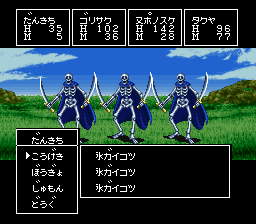
A battle is a series of rounds. In each, the party gives its commands, then everyone acts once in order of speed:
The commands are those of the battle menu (Playing a game): Fight たたかう, which asks each hero for Attack こうげき, Guard ぼうぎょ, Spells じゅもん or Items どうぐ; Auto じどう, which lets every hero choose for itself this round; and Escape にげる Manual pp. 78–79.
The turn order#
| Rule | What it means |
|---|---|
| Once a round | The order is fixed when the commands are in, before anyone acts. A speed up or down changes the next round's order, not this one's |
| Speed, highest first | A hero's speed is agility + the ring; an enemy's is its speed |
| No randomness | The same speeds always give the same order |
| Ties: heroes first | A hero and an enemy at the same speed: the hero acts first |
| Then the lower slot | Two heroes at the same speed act in party order; two enemies, left to right as the group was made |
So だんきち at level 1 (speed 7) against ビービー (12) and ドロドロ (2) always goes second, every round: ビービー, だんきち, ドロドロ.
Status first#
Before anyone acts, the game looks at its status, and the first of these that applies decides the turn:
| Check | Result |
|---|---|
| Out of the fight (fallen, fled) | No turn (an enemy with method 10 may come back instead) |
| Knocked out | 1 in 4: comes round, and that is the turn |
| Paralysed | A hero 1 in 8, an enemy 1 in 4: recovers, and that is the turn |
| Asleep | 1 in 4: wakes, and that is the turn |
| Confused | 1 in 4: recovers, and that is the turn; otherwise a confused attack |
| None of these | The command (or auto, or the enemy's choice) |
A hero who recovers has used the turn on it. "Out of the fight" is a hero or enemy at 0 HP, or an enemy that fled; a hidden enemy comes out at 1 in 4 a turn, and that is its turn too.
Damage#
| Action | Damage | Notes |
|---|---|---|
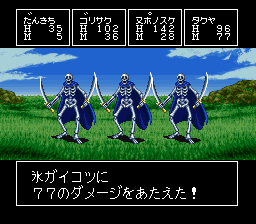
| Attack | (attack − defence) ÷ 2, at least 1 | No hit roll: it always lands. No variance: the same numbers always give the same damage |
| Critical hit | attack − defence, at least 1 | 1 in 16 for everyone; 1 in 4 for an enemy with method 13. The guidebook's "double damage" |
| On a guarding target | Halved again, at least 1 | Attacks, charges and self-destructs, this round only. Spells are not halved |
| Charge (enemy) | attack − defence, at least 1 | Then the charger takes (the target's attack − its own defence) ÷ 2, at least 1, unless the target died or has a status other than poison |
| Self-destruct (enemy) | Half the enemy's HP, at least 1, to every living hero | Only when its HP is at most half its maximum; otherwise nothing happens |
| Steal MP (enemy) | A quarter of the target's MP, at least 1 | Only if the target has MP |
| Damage spell | Its points, exactly | No defence, no variance. Doubled for an enemy with method 11. An enemy is hurt only if the spell "works on it" |
| Poison | 2 HP | After the poisoned one's own action, if it was poisoned when the round began. It can kill |
There is no hit roll and no variance. An attack does the same damage every time, unless it is a critical; a spell does its points. "At least 1" means an attack on a much tougher target still does 1, never 0. When the damage is at least the target's HP, it falls: its HP goes to 0, and every status on it, poison included, gives way to "fallen".
A critical hit is rolled for every attack, by heroes and enemies alike, 1 time in 16 (1 in 4 for an enemy with method 13). It skips the halving, so it does attack − defence: twice the normal damage, or one more than twice when attack − defence is odd. Against defence higher than attack, a critical does 1 too.
Guard halves an attack, a charge or a self-destruct on the guarding hero (or enemy, with method 2) for the rest of the round, after the critical. It does nothing against spells Manual pp. 78–79.
Magic#
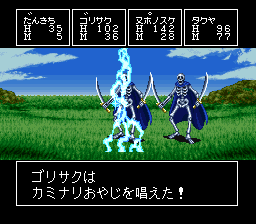
A hero can cast a spell it has learned (its level is at least the spell's level for that hero) if it has the MP; otherwise the turn is lost to "not enough MP". The cost is paid when the spell goes off. A hero can't cast teleport or lift curse in battle; the spell list refuses them.
An enemy casts any spell in its list, and its MP is never checked: enemies have none.
Every spell is exact: its points are the amount, with no defence and no variance (Magic has the 20 effects). Heals stop at the maximum, ups at 9,999 and downs at 1. A damage spell kills when its points are at least the target's HP.
Resistance is all or nothing. An enemy is affected only if the spell is ticked in its magic that works on it list; otherwise the spell does nothing to it at all. A hero is always affected. A sealed caster (effect 8) can't cast: the spell fails and the turn with it.
An enemy with method 11 casts with double points, at most 9,999. An enemy with method 14 misses each target of a spell at 1 in 2, as it misses half its attacks.
Items#
| Kind | In battle |
|---|---|
| HP, MP | Restores its number, up to the maximum |
| Antidote, paralysis cure | Clears that status |
| All-cure | Clears every status and the seal, fills HP and MP; it raises a fallen hero |
| Magic | Casts its spell: points, effect and animation, no MP, not stopped by a seal. Teleport and lift curse are greyed out |
| The others | Do nothing in battle (a weapon in the bag isn't listed) |
An item works as a spell with the same points would, with no MP and no defence. It is used up only if it breaks: after the action, its break chance is rolled, and an item that doesn't break stays in the bag (The break chance). The field uses the same rule.
Status effects#
| Status | Set by | On its turn | Cured by | After the battle |
|---|---|---|---|---|
| Poison | Effect 6; an event command | Acts, then loses 2 HP (it can die of it) | Cure (5), antidote, all-cure; an event command | Stays: in the field, 1 HP a step, never below 1 |
| Paralysed | Effect 7; an event command | No action; recovers at 1 in 8 (an enemy 1 in 4) | Cure (5), paralysis cure, all-cure; an event command | Stays: no spells or changing equipment in the field |
| Asleep | Effect 10 | No action; wakes at 1 in 4 | All-cure | Ends |
| Confused | Effect 9 | Recovers at 1 in 4; otherwise attacks a random hero or a random enemy | All-cure | Ends |
| Knocked out (きぜつ) | Effect 11 | No action; comes round at 1 in 4 | Revive (4), all-cure | Ends |
| Sealed | Effect 8 | A spell it chooses fails, and the turn with it | All-cure | Ends |
| Fallen (HP 0) | Damage | Out of the fight | Only the all-cure; an enemy with method 10 comes back by itself | Back with 1 HP |
| Hidden (enemies) | Method 3 | Can't be targeted; comes out at 1 in 4 | | |
Poison and paralysis outlast the battle; everything else ends with it. A cure in battle (spell or item) also stops the poison damage that turn.
How enemies choose#
On its turn an enemy that can act picks one option, every option at equal odds: each of the methods 1–8 it has (the battle methods) and each spell in its magic it uses list counts as one. So an enemy with Attack, Guard and two spells attacks a quarter of the time and casts half of it. An enemy with nothing ticked does nothing.
Then it picks the target by what it chose:
| The enemy chose | Its target |
|---|---|
| Attack, charge, steal MP | A random hero (with method 12, a random enemy of its own side) |
| Heal one, revive, cure, an up, lift curse | A random living enemy of its own side |
| Heal all | Its own side |
| Poison, paralyse, seal, confuse, sleep, knock out, a down, damage one | A random hero (with method 12, a random living enemy) |
| Damage all | The whole party (with method 12, its own side) |
| Teleport | It vanishes, and the battle ends at once with no experience, gold or chest |
Method 9 makes it choose and act a second time in the same turn. Method 12 turns its attacks and hostile spells on its own side. Method 14 makes each attack, and each target of each spell, fail at 1 in 2, after the critical roll.
An enemy's spell shows no animation, only a sound and a fade of the screen. An enemy that teleports vanishes, and the battle ends at once: no experience, no gold, no chest, and the event that started it goes on. A boss with teleport can walk out of its own fight.
Auto#
Auto じどう works through a fixed list for each hero and takes the first step that it can carry out. It uses no random numbers, and the guidebook gives the same list in short Guidebook p. 132:
| Step | Auto tries | If |
|---|---|---|
| 1 | A damage-all spell on all the enemies | Its points are at least the HP of two or more living enemies. Of those that qualify, the weakest |
| 2 | The same with an item | A magic item whose spell does that |
| 3 | An attack | It kills: (attack − defence) ÷ 2 (at least 1) is at least an enemy's HP. The enemy with the most HP that it kills |
| 4 | The strongest damage spell first | On the enemy with the most HP that the points kill (all enemies, for damage-all) |
| 5 | The same with items | | |
| 6 | Attack the enemy with the least HP | No living hero is at a quarter of max HP or below. Otherwise go on, with each hurt hero's shortfall = max HP ÷ 4 − HP |
| 7 | A heal-all spell, then a heal-all item | Its points cover the shortfall of two or more hurt heroes. The weakest such |
| 8 | The strongest heal spell, then item | On the hurt hero with the largest shortfall whose shortfall it covers |
| 9 | The strongest heal spell, then the strongest heal item | On the hero with the largest shortfall, whatever it covers |
| 10 | Attack the enemy with the least HP | Nothing above could be done |
"Kills" compares the points with the enemy's HP as they stand, without asking whether the spell works on that enemy. Auto never uses an MP item, a cure or the all-cure, and never casts a status spell, an up or a down: those are the menu's to choose. An item in the bag counts however many are left. "Castable" is the hero's level and MP as for the menu, with one difference:
Escape#
Escape にげる works if the round's roll says so. The roll is made at the start of every round, on the speeds of the heroes and the enemies still in the fight:
| Test, in this order | Escape chance |
|---|---|
| The slowest hero is at least as fast as the fastest enemy | Always |
| The slowest enemy is at least as fast as the fastest hero | 1 in 16 |
| The heroes' average speed is below the enemies' | 1 in 8 |
| Otherwise | 1 in 4 |
| A battle started by an event | Never |
So だんきち alone (speed 7) always escapes from ドロドロ (2), but from ビービー (12) only 1 time in 16. Speed is the only stat that counts. A battle started by an event can't be escaped at all Manual pp. 78–79.
The surprise round#
A random battle opens 1 time in 32 with 敵が いきなり おそってきた! ("the enemy attacked suddenly!"). In its first round the heroes get no commands and only the enemies act. Event battles never open this way.
After the battle#
Rewards#
Each enemy killed adds its experience and gold to the battle's totals (at most 9,999,999 experience and 999,999 gold). At the end, every living hero gets the whole experience total, not a share of it; a hero who has fallen gets nothing. The gold goes to the party. An enemy that fled gives nothing.
Experience and levels#
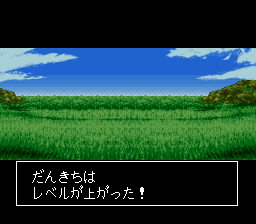
The experience a hero needs is a fixed total for each level, the same for every hero Manual p. 94:
| Level | Total experience | Level | Total experience |
|---|---|---|---|
| 1 | 0 | 11 | 1,084 |
| 2 | 10 | 12 | 1,633 |
| 3 | 25 | 13 | 2,456 |
| 4 | 47 | 14 | 3,690 |
| 5 | 80 | 15 | 5,541 |
| 6 | 129 | 16 | 8,317 |
| 7 | 202 | 17 | 12,481 |
| 8 | 311 | 18 | 18,727 |
| 9 | 474 | 19 | 28,096 |
| 10 | 718 | 20 | 42,149 |
From level 21 on, every level costs exactly 32,768 more: level L takes (L − 20) × 32,768 + 42,149. The highest level is 99.
| Level | Total experience |
|---|---|
| 21 | 74,917 |
| 22 | 107,685 |
| 25 | 205,989 |
| 30 | 369,829 |
| 40 | 697,509 |
| 50 | 1,025,189 |
| 60 | 1,352,869 |
| 70 | 1,680,549 |
| 80 | 2,008,229 |
| 90 | 2,335,909 |
| 99 | 2,630,821 |
A level-up adds the hero's five gains to its stats and works out attack, defence, speed, max HP and max MP again (How stats grow). Several levels at once each add their gains. HP and MP are not refilled.
The chest#
The last enemy killed decides whether there is a chest, by its chest rate c and with its item (Battle settings):
- c = 0: never; c = 100: always;
- otherwise a chest comes up when the roll is below c + the living heroes' average luck ÷ 100 (both rounded down).
So a hero's luck adds 1 to the rate for each full 100 of the average, and nothing below that. The roll is a number from 0 to 255, divided by 101, with the remainder compared: the remainders 0–53 come up three times in 256, the rest twice, so the real chances are a little higher than the rate:
| Chest rate (+ luck) | Real chance |
|---|---|
| 0 | Never |
| 1 | 1.2 % |
| 5 | 5.9 % |
| 10 | 11.7 % |
| 20 | 23.4 % |
| 30 | 35.2 % |
| 50 | 58.6 % |
| 75 | 79.7 % |
| 99 | 98.4 % |
| 100 | Always |
Back to the field#
A fallen hero comes back with 1 HP. Of the statuses only poison and paralysis stay; the seal goes. If the whole party falls, the game says that the leader's party lost the fight and goes back to the title menu. Nothing is saved, and play since the last save is lost (Playing a game).
Encounters#
A random battle can start on each step, on foot or aboard the sea vehicle; never on the land vehicle or in the air. The chance depends on the screen's rate (0–8, set in Enemy Map Editing, Enemy maps; 0 is none) and on the steps since the last battle, which start again from 0 after each battle and on each change of map:
| Rate | Steps 1–2 | Step 3 | Steps 4–7 | Steps 8–12 | Steps 13–15 | Step 16 on |
|---|---|---|---|---|---|---|
| 1 | – | – | 0.4 % | 1.6 % | 3.1 % | 6.2 % |
| 2 | – | – | 0.8 % | 3.1 % | 6.2 % | 12.5 % |
| 3 | – | 0.4 % | 1.6 % | 6.2 % | 12.5 % | 25 % |
| 4 | – | 0.8 % | 3.1 % | 12.5 % | 25 % | 50 % |
| 5 | – | 0.8 % | 3.5 % | 14.1 % | 28.1 % | 56.2 % |
| 6 | – | 0.8 % | 3.9 % | 15.6 % | 31.2 % | 62.5 % |
| 7 | – | 2 % | 4.3 % | 17.2 % | 34.4 % | 68.8 % |
| 8 | – | 2.3 % | 4.7 % | 18.8 % | 37.5 % | 75 % |
The first two steps after a battle are always safe, and the chance climbs in stages from there, so that battles come at a fairly even pace rather than in clumps. At rate 4, half of all battles have come by the 12th step and four in five by the 15th; at rate 8, by the 10th and the 13th; at rate 1, only by the 23rd and the 37th. The screen also needs at least one enemy set for it, and on the field one of the right kind: land enemies on foot, sea enemies aboard the sea vehicle (Enemies).
The group. The game shuffles the enemies the screen allows and draws how many different kinds to take, then how many enemies in all, each up to 4 with a full party, or one more than the party's size: a lone hero meets at most 2. The extra enemies are repeats of those chosen. Enemies are left out if the group's pictures together would be wider than the screen.
The background comes from where the battle is: on a map, from the map's battle background setting (a dungeon by its map type, a town or a castle one of two at random); on the field, from the terrain under the party. The 17 backgrounds are in the catalogue, and the rules in Enemy maps.
The random numbers#
Every roll above comes from one generator: s = s × 5 + 14,097, kept to 16 bits, with each step's top byte as the number (0–255). Three things follow from how it is used:
- It is never seeded. The starting value is whatever the console's memory held at power-on, so each time the console is switched on the sequence starts somewhere new; a reset keeps the running value.
- It runs all the time. While the game waits for each frame, it draws about 350 numbers, more or fewer with the frame's work. So which number a battle gets depends on exact timing: the same presses don't give the same battle twice, and no battle can be predicted from the pad.
- "1 in n" is a remainder. Rolls such as "a number below n" take the byte's remainder by n, so for n that doesn't divide 256 the small remainders come up a little more often. That makes no difference to the 1-in-4 and 1-in-16 rolls (they are exact), and a small one to the chest and the break chance (above).
The generator and its place in the program are in How it works.
Fan-made reference material, one of the Eschaton Games Tsukuru guides. Not affiliated with the publishers of the titles it covers.