Behind the scenes#
Who made RPG Tsukuru 2, what they left in the cartridge besides the program, the add-ons it was built to work with, and how the study behind this guide was done.
The studio#
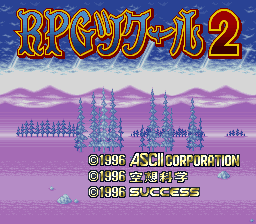
RPG Tsukuru 2 was published by ASCII on 31 January 1996 (one listing gives the 30th). The cartridge is SHVC-ZR2J, its header names it RPG-TCOOL 2, and its maker code is ASCII's.
The developer is Kuusou Kagaku 空想科学 ("fantasy science"), credited on the title screen and again at the end of every game. It left its name inside the program too: just below the cartridge header sits the text KUSOU KAGAKU DEVELOPMENT SYSTEM VER 2.28, the name and version of the studio's own development system. Super Dante, the first RPG Tsukuru on the Super Famicom, carries the same tag at the same place, at version 2.21. On the PlayStation, Kuusou Kagaku's logo film opens RPG Tsukuru 3. So the line Super Dante → RT2 → RT3 is one studio's work, and RPG Maker, RT3 translated, is its last step (Compared with RT3). Two other Tsukuru cartridges of the time, Kanadeeru and Sound Novel Tsukuru, have no such tag.
The title screen and the closing cards also name SUCCESS, ©1996, beside ASCII and Kuusou Kagaku. Nothing in the program says what its part was.
The ending runs in a fixed order: one staff roll with the game's own credits from Title Settings woven in (its scenario and map design first, its special thanks among RT2's), then the ©1996 ASCII, 空想科学 and SUCCESS cards, and back to the opening demo.
Before RT2: Super Dante#
Super Dante (SHVC-ARDJ: 1 MB, 32 KB of battery memory) is RT2's predecessor, and much of its core is RT2's code. Compared byte for byte, the two cartridges share 412 runs of 32 bytes or more, 46,962 of RT2's bytes, about 2 % of its ROM; the start-up code sits at the very same addresses, the core library a few bytes away.
| In both cartridges | Only in RT2 |
|---|---|
| The start-up and interrupt code, at the same addresses | The sound driver (Super Dante has a different one) |
| The core library: DMA, multiply and divide, the random-number generator, the decompressor, the object system | The save's checksums and the power-on check |
| Windows, cursors and sprites, and most likely the script machine | The tile packer, one of RT2's two graphics decompressors |
| The development tag (Super Dante's version 2.21, RT2's 2.28) | The encounter check and the start of a battle |
| The event interpreter's core, in the same order | The editors, almost entirely |
| The text routine | |
| Pieces of the battle and of the field's code, among them the Mode 7 air view and its tables | |
| The Turbo File library |
The guidebook says Super Dante held about 1/2.5 as much game as RT2 Guidebook pp. 8–9. Super Dante is the next cartridge this project studies.
The factory save and the sample game#
The last 64 KB of the ROM is a whole battery image, exactly what the cartridge's save memory holds: a header, three play saves and a complete game, the sample, だんきちのバクチンだいさくせん!! (The sample game). Loading the sample in the editor copies it from there; playing the Sample Game runs it straight from the ROM, whatever the editor holds. The sample's credits read T.MOMOKURI and だいザム・まこBE; the teacher in its story is モモグリ.
The image was made from a development cartridge's memory and copied whole, so it carries what was in that memory beyond the game's own data (below). It is not a safety net: a save that fails the power-on check is formatted to an empty project, never restored from the factory image.
The sample game ends with a caption: years later the hero finished his RPG, won the prize and the girl, "and RPG Tsukuru 3's release day came". In the last scene a shop sells RT3. A game released in January 1996 was already advertising its successor.
Hidden content#
The development tag, and the reset#
The studio's tag below the header has a second job. At start-up the program compares it with a copy in the console's working memory. After power-on there is no copy: the program writes one and shows the boot screens before the opening demo. After the console's Reset button, which leaves working memory as it was, the copy is found and the program goes straight to the opening demo.
Holding L + R + START + SELECT returns to the title menu from play or from the opening demo, skipping the save check. It is not a secret: the manual gives it in one line on its controls page Manual pp. 4–5.
A test page in the factory save#
RT2's formatter never touches the last kilobyte of the first half of the save memory, and the factory image keeps what the development cartridge had there. From that spot runs stale event code: one event page of 149 commands that goes through the whole command set, each command followed by a warp, back and forth between map 86 and the world map:
- a message of every hiragana and a caption of every katakana, with the punctuation and ♪; yes/no branches; switch 240 on and off;
- a battle, a short wait, item 127 given and taken, experience, an inn at 1 gold, a shop of the sample's items, a save point, 900,000 gold given and taken, a BGM and a sound;
- every facing and step of the event and of the hero, in all three step styles; a blink, both spins; HP and MP up and down; hero 11 joining and leaving;
- poison, paralysis and the cure; flash, shake, the eight screen tints, both mosaics, the fades, and vanish.
After it come an ending command, fragments of other pages and another copy of the same commands without the warps. It reads as the developers' test of the event interpreter, left in because the image was copied whole. Nothing reads it.
No debug menu, no orphan text#
- No debug menu: every mode the main loop can enter is accounted for, the unused ones are stubs that are never entered, and no hidden routine reads the controller.
- No orphan text: every run of the program that reads as Japanese or English is a string the program shows, or is not text at all; 241 candidates were checked by hand. The only plain-ASCII text is the tag, the header's name, the save's signature and the names RT2 gives its Turbo File and memory pack files.
- Unused data: a few text palettes beside the fonts that nothing reads.
- Bugs: unequipping loses the item, the inn's price is taken from only part of the gold, the escape roll can miss a living enemy, and a few smaller ones (Limits and bugs).
The storage add-ons#
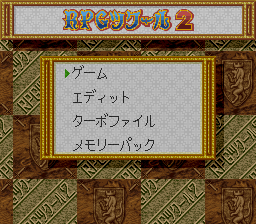
The cartridge holds one user game. Two add-ons hold more, and RT2 puts both on its top menu.
The Turbo File Twin#
ASCII's Turbo File Twin is a battery-backed box that plugs into the second controller port. RT2 works with it only in its STF mode, not the earlier Turbo File or Turbo File II Manual pp. 6–7. All four of the Super Famicom Tsukuru cartridges carry the same driver for it.
An RT2 game on the Twin is one file of 62 one-kilobyte blocks, named RPG-TCOOL2-01 or -02: the whole save memory but its signature, play saves included, so a game carried to a friend's cartridge arrives with its saves. Two games fill the Twin's 124 blocks exactly. The program reads every block twice, and reads back every block it writes. RT2's delete page lists every file on the Twin, other games' too (a Super Dante file shows as SUPER DANTE, 32 blocks); an unformatted Twin is formatted without a question, and a damaged file found while loading is deleted, leaving the cartridge untouched. All of this was run in an emulator that has the device; no real Twin has been tried yet.
The memory pack and the Satellaview#
The cartridge has a slot on top for an 8-megabit Satellaview memory pack, the flash card of Nintendo's satellite-broadcast add-on. RT2 saves a game to one of the pack's eight 128 KB blocks, so a pack holds eight games Guidebook pp. 106–107, in the same form as on the Twin, with a header in the Satellaview's own format.
Because a Satellaview would list such a file as a program it could run, RT2 puts a tiny program in each one. Read from the code (it hasn't been run), all it does is show BS-Xカセットでは利用できません。 ("this can't be used on the BS-X cartridge").
The code also lets a game on a pack be played straight from the pack, without loading it into the cartridge (read from the code, not tried). A play save then remembers the pack game's title and checksum and finds it again at power-on, wherever on the pack it now sits.
What was planned for the pack#
The manual says graphics, music and game data were planned for broadcast on St.GIGA, the Satellaview's station, to be saved to a pack and used from RT2 Manual pp. 72–73. The program is ready for them. It recognises five kinds of file on a pack:
| File | What |
|---|---|
| RPSV | A game RT2 saved |
| RPSM, RPSX | Game files RT2 doesn't write, handled like its own: broadcast games, presumably |
| RPGR | Graphics: extra map part sets, enemy graphics and palettes |
| MTTC | Music: songs played as BGM 31 and up |
The Data page's two memory-pack choices pick a graphics file and a sound file, and the BGM settings have a slot for maps of the pack's extra kinds. The music file is, by every sign, the one the Super Famicom Kanadeeru, ASCII's music maker, writes: its ROM holds the template of exactly that file, and its sound driver is a sibling of RT2's. No graphics file and no broadcast game is in any of the four Tsukuru ROMs, and none is known to survive.
The two second-hand cartridges#
The study had RT2's ROM and the saves of two second-hand cartridges, previous owners' work. Each game has a page of its own; their makers are not named anywhere in this guide.
- The first holds a Mito Kōmon game built on the sample's world: a new title, new credits, eight heroes from the Mito Kōmon cast, new items and magic, on the sample's maps and events, which are unchanged (the event memory is the factory's byte for byte). Its one play save is of the sample game.
- The second holds A Rising Shadow, an original fantasy game written in English capitals, on maps of its own, unfinished: every event has one page and no switch is used at all, there is no ending, and signposts name places that have no events yet. Its play saves are a test play and two of the game, the furthest party at levels 14 and 15. It also remembers a game once played straight from a memory pack.
The two saves were the real test data for every format: a save made by RT2's own editor in someone's hands, beside the factory one.
The misread dump#
The second cartridge's save was first dumped wrong, and the way it went wrong is a lesson for anyone dumping these cartridges.
That first dump failed RT2's own power-on check. RT2 checks a 24-byte signature, nine section checksums and a total every time it is switched on, and on any mismatch it erases the whole project at once, with no question. Compared with later dumps, the first had 121 wrong bytes, all within 27 bytes of a 1 KB boundary and most of them the bytes 1 KB away: the dumping device's address line for 1 KB had lagged after many boundaries. After the cartridge's contacts were cleaned, four more dumps came back identical and passed every check. The memory itself was intact.
How this study was done#
Everything in this guide comes from the program itself, not from the books, which are cited and corrected where they disagree.
- An emulator run headless. Mesen 2, driven by a script with no window: saved states, scripted button presses, memory watched, traced and dumped, screenshots taken from the emulated screen. Every run worked on a copy of a save.
- A code/data log. The emulator marks each byte of the ROM as code or data as it runs. 318 runs, from power-on, from every menu, editor and screen, and with random buttons pressed, marked 90,300 bytes of code. A disassembler written for the study reads the log.
- The editor as a probe. To learn what a byte of the save means, one field was changed in RT2's own editor on a copy, the save written, and the battery memory compared before and after. Then the code that reads it was found. Every save was finally rebuilt byte for byte from its decoded form.
- Battles replayed. Every random number a battle drew was recorded at the place in the code that drew it, then the battle was replayed turn by turn through a model of the rules written from the code. Forty-one recorded runs, over 1,300 turns, every escape roll and every treasure chest, reproduce exactly.
- A second emulator. So that nothing rests on one emulator's quirks, ten battles and six screens were repeated in bsnes beside Mesen, from the same starting memory. Each emulator's battles replay exactly through the same model (672 turns in one, 670 in the other) and the screens agree pixel for pixel. On the way it showed that RT2 never seeds its random numbers (they start from whatever the console's memory held at power-on) and turned up the escape bug.
- The add-ons in emulators that have them: MesenCE for the Turbo File Twin, Mesen for the memory pack.
- The pictures and sounds of this guide come from the ROM by the study's tools: the graphics drawn from the game's own data, every song and effect played through the game's own sound driver, every screenshot taken by script in bsnes from power-on with the factory save.
The work ran as twelve steps, each finished with its notes, a tool and a check:
| Step | What it settled | How it was checked |
|---|---|---|
| Before the plan | The dumps; the power-on check; the text code; the event heap; the books read | Every name in three saves decoded; every event page parses |
| Which of the 2 MB is code, the main loop and its modes, the routines everything calls | A code/data log of 318 emulator runs: 90,300 bytes of code seen running |
| Every byte of the 64 KB, the checksums, the three play saves | The factory save and both cartridges' saves rebuilt byte for byte; a built save plays |
| What each of the 75 command codes does; how a page is chosen | Test events running every command, their effects read back from a play save |
| Chips, parts, screens, the world map; the two decompressors | All 59 maps and world maps of the three saves drawn, eight matched to the emulator pixel for pixel |
| Every rule, and the random numbers | Battles recorded number by number and replayed by a model of the rules, turn for turn |
| The field and its menus, saving, inns, shops, vehicles, movement, test play, the ending | Each tried in play; random battles replayed |
| The sound driver, the songs and effects, instruments and samples | All 30 songs and 65 effects played back from the game's own driver |
| The two add-ons' files and RT2's pages for them | Saved, loaded and deleted in emulators that have the devices |
| The script machine behind every window, and every string the program shows | 1,634 scripts reached; 1,768 strings dumped |
| The sample game's story, leftovers, the reset, the test page | The three saves' events written out as scripts; each find run |
| Whether anything depended on one emulator | The battles and screens repeated in bsnes: no disagreement |
| The lineage against RT3; Super Dante prepared | The two ROMs compared byte for byte |
What's left open#
RT2 counts as decoded: every format a game is made of is read and written back. These points are not settled:
| Still open | Why |
|---|---|
| The memory pack's graphics file: which table entry is which, and the data behind them | No such file is known to survive; the format is known only from the code that would read it |
| How the SFC Kanadeeru's songs reach RT2, and the streamed samples a pack's sound file can carry | Belongs to the study of Kanadeeru, whose ROM holds the pack file's template and a sibling of RT2's sound driver |
| Two Turbo File functions RT2 never called, a few rare error codes, and what the device's write-protect and battery bits do to RT2 | The emulator doesn't set those bits; a real Turbo File Twin is on its way |
| The names of the instruments and samples | To be done by ear |
| The battle test in Enemy Map Editing | Not yet run in the emulator; nothing waits on it |
| Code that never ran and that no live mode reaches | Only the table of modes was surveyed; a full pass over the program is left |
| The other fragments of the development test page | Read as fragments, not decoded one by one |
| Whether the sample game's "set but never tested" switches are tested inside a page | The script dump shows page conditions, not the branches inside a page |
| The command code that ends an event, run as written | The game turns it into another code before running it, so its own routine never runs |
Fan-made reference material, one of the Eschaton Games Tsukuru guides. Not affiliated with the publishers of the titles it covers.