Covers Manual pp. 18–27 Manual pp. 56–67.
The database#
The database is everything a game knows before its story starts: its title and credits, the heroes and how they grow, the three vehicles, where the party begins, the music for each kind of place, and the items, spells and enemies. Five entries of the Edit menu エディット hold it (Getting started):
| Entry | Japanese | What it holds | How many |
|---|---|---|---|
| Title Settings | タイトルの設定 | The game's title and three credit lines | 1 |
| Hero Settings | 主人公キャラ設定 | Heroes, vehicles, the starting party, the BGM slots | 12 heroes, 3 vehicles, 11 slots |
| Item Editing | アイテムの編集 | Items in 15 kinds | 127 |
| Magic Editing | 魔法の編集 | Spells, shared by heroes and enemies | 64 |
| Enemy Settings | 敵キャラの設定 | Enemies: field, dungeon and event | 96 |
Each editor works on a copy and writes only its own part to the cartridge, when you choose Save from its R menu (The R menu and saving). Its Sample Load fills that one editor with the sample game's data: a quick way to see a working example, and a good start for your own. The maps and the events have their own chapters (Maps and the field, Events); what the numbers do in a fight is How battles work.
Title and credits#
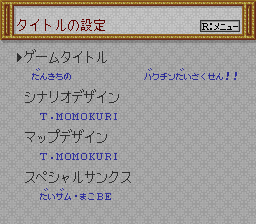
Title Settings タイトルの設定 holds the game title, two lines of 14 characters, and three credit lines of 14 under headings you can't change: Scenario Design シナリオデザイン, Map Design マップデザイン and Special Thanks スペシャルサンクス Manual pp. 18–21 Guidebook pp. 104–105. When an event sends the game to its ending, the scenario and map design lines open the staff roll, RT2's own staff follow, and the special-thanks line joins RT2's own special thanks near the end (Playing a game).
The sample game is called だんきちの バクチンだいさくせん!!, and its credits read T.MOMOKURI, T.MOMOKURI and だいザム・まこBE.
Heroes#
Hero Settings 主人公キャラ設定 opens four pages: Heroes キャラクタの設定, Vehicles 乗り物の設定, Party パーティーの設定 and BGM BGMの設定.
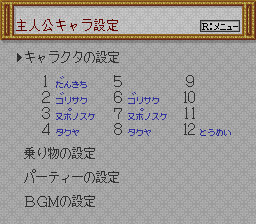
A game has 12 heroes, of whom up to four are in the party at once. Events bring them in and take them out (Events). Each hero has:
- a name 名前 of up to 5 characters;
- a graphic グラフィック, 1 to 72: ↑ ↓ step by one, ← → by ten Manual pp. 22–27. Graphic 1 is transparent, and 2–72 are the character sheets of the catalogue;
- five gains per level, for strength, vitality, wisdom, agility and luck;
- the start settings 初期設定: start level, start equipment and the level each spell is learned at.
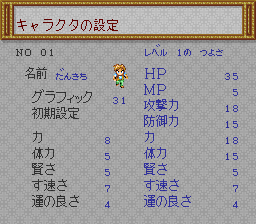 123456789101112
- 1 Hero number NO 01 heroes 1-12; up to 4 in the party
- 2 Name 名前 だんきち up to 5 characters, on the keyboard page
- 3 The graphic the chosen character graphic as it walks
- 4 Graphic グラフィック 31 one of 72 character graphics: up and down step 1, left and right 10
- 5 Initial settings 初期設定 opens the start level, start equipment and spell levels
- 6 Strength gain 力 8 strength gained per level: attack = strength + weapon
- 7 Vitality gain 体力 5 vitality gained per level: it sets HP and defence
- 8 Wisdom gain 賢さ 5 wisdom gained per level: max MP = wisdom
- 9 Speed gain す速さ 7 speed gained per level: turn order, escaping
- 10 Luck gain 運の良さ 4 luck gained per level: raises the chance of a chest after a battle
- 11 Stats at level 1 レベル 1の つよさ the level the right column is worked out for: the start level
- 12 The stats HP … 運の良さ stat = base + level x gain; bases HP 30, attack, defence, strength and vitality 10, the rest 0
How stats grow#
The five numbers are not stats but gains: what each level adds. The right side of the page, レベル 1の つよさ ("strength at level 1"), shows what they make at the start level. At level L a hero has:
| Stat | Japanese | At level L, with gain g | What it makes |
|---|---|---|---|
| Strength | 力 | 10 + L × g | Attack = strength + the weapon's number |
| Vitality | 体力 | 10 + L × g | Defence = vitality + armour + shield + helmet; max HP = vitality + 20 |
| Wisdom | 賢さ | L × g | Max MP = wisdom |
| Agility | 素早さ | L × g | Speed = agility + the ring's number |
| Luck | 運の良さ | L × g | Nothing but the chest after a battle (below) |
So max HP is 30 + level × the vitality gain: HP grows by that gain and nothing else. A level-up adds each gain to its stat and works out attack, defence, speed and the maximums again, the equipment included. It doesn't refill HP or MP (Experience and levels).
Worked example: the sample's hero 1, だんきち, has the gains 8, 5, 5, 7, 4 and starts at level 1 with nothing equipped:
| Level | Strength (8) | Vitality (5) | Wisdom (5) | Agility (7) | Luck (4) | Attack | Defence | Speed | Max HP | Max MP |
|---|---|---|---|---|---|---|---|---|---|---|
| 1 | 18 | 15 | 5 | 7 | 4 | 18 | 15 | 7 | 35 | 5 |
| 10 | 90 | 60 | 50 | 70 | 40 | 90 | 60 | 70 | 80 | 50 |
| 20 | 170 | 110 | 100 | 140 | 80 | 170 | 110 | 140 | 130 | 100 |
| 50 | 410 | 260 | 250 | 350 | 200 | 410 | 260 | 350 | 280 | 250 |
At level 1, strength is 10 + 1 × 8 = 18, so his attack is 18. Vitality is 10 + 1 × 5 = 15, so his defence is 15 and his max HP 15 + 20 = 35. Wisdom 5 gives max MP 5. This agrees with the guidebook's shot of the same hero. A gain may be 0–99 Guidebook pp. 22–23, and stats aren't held at 999: the guidebook shows an attack of 6,835 at level 91 Guidebook pp. 8–9.
What the stats do#
- Attack and defence: an attack does (attacker's attack − target's defence) ÷ 2 (Damage).
- Speed: the order of turns each round, and the odds of escaping (The turn order, Escape).
- Wisdom gives MP and nothing else: spells do their points whoever casts them.
- Luck only raises the chance of a chest after a battle, and only by one point for each full 100 of the living heroes' average luck (The chest).
Start settings#
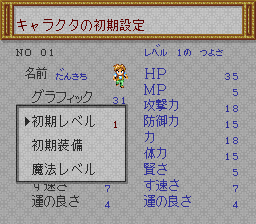 123456
- 1 Initial settings キャラクタの初期設定 the hero's state at the start, or when they join the party
- 2 Start level 初期レベル 1 0-99; a later joiner's level when they join
- 3 Start equipment 初期装備 weapon, armour, shield, helmet and ring, or none
- 4 Spell levels 魔法レベル per spell, the level it is learned at, or never
- 5 Stats at level 1 レベル 1の つよさ the right column follows the start level
- 6 The stats HP … 運の良さ stat = base + level x gain
- Start level 初期レベル: the level the hero has at a new game, with the stats it gives. Heroes out of the party gain no experience, so a hero who first joins later in the game joins at this level Manual pp. 22–27.
- Start equipment 初期装備: one item for each of the five slots, weapon 武器, armour 鎧, shield 盾, helmet 兜 and ring 指輪, or none. An item counts only if its kind is the slot's and the hero may equip it (Items).
- Spell levels 魔法レベル: for each of the 64 spells, the level at which this hero knows it, or never.
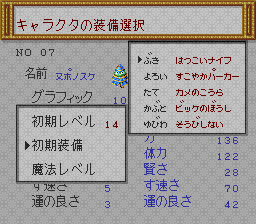
The sample uses the start level to have a character come back stronger. Heroes 2–4 are three classmates at school; heroes 6–8 are the same three for the later quest, with the same gains but higher start levels (ゴリサク 2 and 12, ヌポノスケ 5 and 14, タクヤ 7 and 11), and the second ヌポノスケ arrives already equipped. Hero 12, とうめい ("transparent"), has graphic 1 and no gains: the sample starts the game with him alone, for an opening with no one on screen (The party).
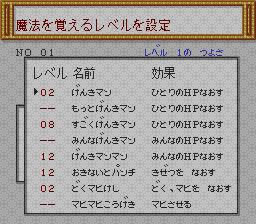
The spells are shared. There is one list of 64, and each hero learns from it at the levels set here. A spell that no hero learns is one only enemies can use Guidebook pp. 84–85. だんきち learns these:
| Level | Spell | Effect | Points | MP |
|---|---|---|---|---|
| 2 | げんきマン | Heal one | 30 | 2 |
| 2 | どくマヒけし | Cure poison and paralysis | | 3 | |
| 2 | ねこパンチ | Damage one | 31 | 3 |
| 5 | ワープー | Teleport | | 5 | |
| 5 | かえんベイベー | Damage all | 25 | 5 |
| 8 | すごくげんきマン | Heal one | 9,999 | 9 |
| 10 | なだれギャル | Damage all | 69 | 22 |
| 12 | げんきマンマン | Heal all | 100 | 20 |
| 12 | おきないとパンチ | Revive | | 22 | |
| 12 | ラブリーチョップ | Damage one | 180 | 28 |
| 14 | はらじゅくビーム | Damage all | 150 | 30 |
A hero can cast a spell once it is learned and the MP is there. The field's spell list shows them in the order they are learned (Playing a game).
Vehicles#
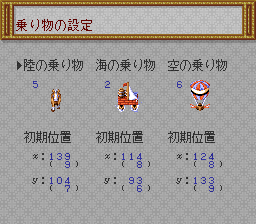
There are three vehicles, land 陸, sea 海 and air 空, each with a graphic and a start position 初期位置 on the field (x and y in tiles, the screen in brackets) Manual pp. 26–27. There are eight graphics Guidebook pp. 46–47:
| Graphic | Japanese | Vehicle | In the sample |
|---|---|---|---|
| 1 | | None: the slot has no vehicle | | ||
| 2 | いかだ | Raft | The sea vehicle |
| 3 | 帆船 | Sailing ship | | |
| 4 | ホバークラフト | Hovercraft | | |
| 5 | 馬 | Horse | The land vehicle |
| 6 | 気球 | Balloon | The air vehicle |
| 7 | 飛空艇 | Airship | | |
| 8 | ドラゴン | Dragon | |
What a vehicle does comes from its slot, not its graphic: the slots behave like this whatever they look like (Vehicles):
| Slot | Japanese | Goes | Battles | Gets off |
|---|---|---|---|---|
| Land | 陸 | Wherever the party can walk | None | A, where it may stop |
| Sea | 海 | On water | With the field's sea enemies | By stepping onto land |
| Air | 空 | Over everything, in a tilted (Mode 7) view | None | A, over grass or snowfield only |
Each plays its own BGM slot while it is ridden (BGM). A vehicle stays where it was left. An item of the call a vehicle kind brings one to the party (Items). The pictures are in the catalogue.
The party#
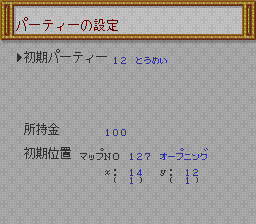
Party パーティーの設定 sets how a new game begins Manual pp. 26–27:
- Start party 初期パーティー: up to four heroes, in order.
- Gold 所持金: the money the party starts with, up to 999,999.
- Start position 初期位置: the field or one of the maps, and the x and y on it.
The sample starts with 100 G, and with only hero 12, the transparent とうめい, on map 127, オープニング (the opening). That map is where its opening caption plays, on an empty screen. The guidebook builds an opening the same way (Events).
BGM#
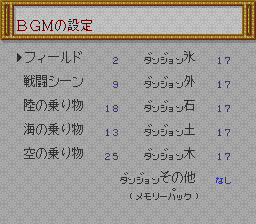
BGM BGMの設定 picks a song (1–30, or none) for each of 11 slots Manual pp. 26–27. The game then plays the slot's song wherever it applies:
| Slot | Plays | The sample's song |
|---|---|---|
| Field | On the field, on foot | 2 |
| Battle | In random battles | 9 |
| Land vehicle | Riding the land vehicle | 18 |
| Sea vehicle | Riding the sea vehicle | 13 |
| Air vehicle | Riding the air vehicle | 25 |
| Ice | Maps of the ice type (こおり) | 17 |
| Outside | Maps of the outside type (そと) | 17 |
| Stone | Maps of the stone type (いし) | 17 |
| Earth | Maps of the earth type (つち) | 17 |
| Wood | Maps of the wood type (き) | 17 |
| Other | Map types from a memory pack (その他) | None |
A battle started by an event plays the song that event gives it, and an event can change the music until the next battle (Events). The Other slot is for map types a memory pack would have added. The songs and where the game plays its sound effects are in Music and sound.
Items#
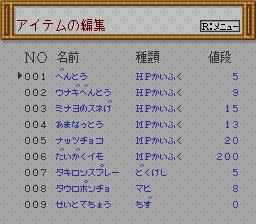
Item Editing アイテムの編集 holds 127 items Manual pp. 60–63. Items have no pictures. Each has these fields:
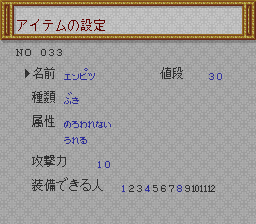 12345678
- 1 Item settings アイテムの設定 one of 127 items; items have no graphics
- 2 Item number NO 033 001-127
- 3 Name 名前 エンピツ up to 8 characters
- 4 Price 値段 30 0-9999; shops buy it back at half
- 5 Kind 種類 ぶき one of 15 kinds, here a weapon; the fields below follow the kind
- 6 Attributes 属性 のろわれない うれる cursed or not (equipment only: it cannot be removed), sellable or not
- 7 Attack 攻撃力 10 added to the wearer's attack
- 8 Who can equip 装備できる人 heroes 1-12; the bright numbers can (here 1, 4 and 8)
| Field | Japanese | Values | What it does |
|---|---|---|---|
| Name | 名前 | 8 characters | | |
| Price | 値段 | 0–9,999 | A shop's price. A shop buys it back at half, rounded down, at least 1 G |
| Kind | 種類 | 15 kinds (below) | What the item is |
| Break chance | 破損率 | Always (かならずこわれる), never, or a % | The chance that one use uses it up (below) |
| Cursed | 属性 | Cursed or not | Equipment only: once on, it can't come off |
| Sellable | 属性 | Sellable (うれる) or not | A shop says うれない for one that isn't |
| The number | | 0–9,999 | Attack, defence, speed, the points restored, the spell, the vehicle or the key, by kind | |
| Who can equip | 装備できる人 | Any of the 12 heroes | For the five equipment kinds |
The 15 kinds#
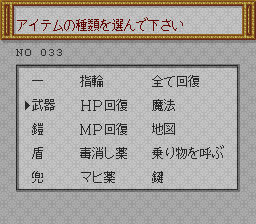
What an item does depends on its kind, and its one number means something different for each:
| Kind | Japanese (as the manual prints it) | Its number | What it does |
|---|---|---|---|
| None | 一 | Unused | Nothing. For things the story needs: letters, passes, a lost ring. An event page can ask for it |
| Weapon | 武器 | Attack added | Equipped in the weapon slot |
| Armour | 鎧 | Defence added | Equipped in the armour slot |
| Shield | 盾 | Defence added | Equipped in the shield slot |
| Helmet | 兜 | Defence added | Equipped in the helmet slot |
| Ring | 指輪 | Speed added | Equipped in the ring slot |
| HP | HP回復 | HP restored | Used on one hero, in the field or in battle, up to the maximum |
| MP | MP回復 | MP restored | The same for MP |
| Antidote | 毒消し薬 | Unused | Cures poison |
| Paralysis cure | マヒ薬 | Unused | Cures paralysis |
| All-cure | 全て回復 | Unused | In battle: clears every status and the seal and fills HP and MP, even on a fallen hero |
| Magic | 魔法 | A spell | Casts that spell with its points and animation, for no MP and even when sealed. In the field only the five field effects work; in battle, all but teleport and lift curse |
| Map | 地図 | Unused | Shows the whole field with the party blinking on it. Not on a dungeon map |
| Call a vehicle | 乗り物を呼ぶ | 0 land, 1 sea, 2 air | Puts that vehicle on the cell ahead, on the field only, where it can stand and no one is in the way |
| Key | 鍵 | 0–3: key A–D | Opens the event ahead whose start is "key A" to "key D" (Events) |
Equipment (weapon to ring) is worn, not used: chosen in the field's Equip command, or given as start equipment. Its number is added to attack, defence or speed while it is on, and only the heroes ticked under who can equip 装備できる人 can wear it. A shop shows each hero's attack, defence and speed with the item, or that the hero can't equip it (Playing a game).
A cursed item can't be taken off or swapped once it is on, and the game says 呪われてしまった! ("cursed!") when it is put on. The field's equipment list marks it with a skull. The lift curse spell (effect 20) takes it off, and the item is lost.
The break chance#
The break chance 破損率 is the chance that one use uses the item up. With always かならずこわれる (100) every use takes one from the bag; with 0 the item is never used up; in between, each use rolls. An item that doesn't break stays in the bag, so the HP and MP items of a normal game want "always". The sample's map and vehicle-calling items are set to never.
The roll is a little kinder to breaking than the figure says, up to about 54: a number from 0 to 255 is divided by 101 and the remainder compared with the chance, and the remainders 0–53 come up three times in 256 against twice for the rest. The same roll decides the chest after a battle (The chest).
| Break chance set | Real chance a use uses it up |
|---|---|
| 0 | Never |
| 1 | 1.2 % |
| 10 | 11.7 % |
| 25 | 29.3 % |
| 50 | 58.6 % |
| 75 | 79.7 % |
| 90 | 91.4 % |
| 99 | 98.4 % |
| 100 (always) | Always |
The break chance means nothing for equipment, which is never used.
Selling#
A shop sells an item at its price and buys it back for half, rounded down, and never for less than 1 G: an item priced 0 that can be sold fetches 1 G. An item set as not sellable shows うれない in a shop's list and can't be sold. Price is the shop's price only: there is no separate selling price.
Magic#
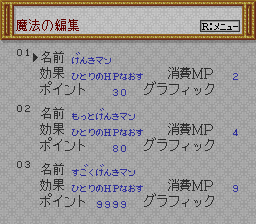 12345678
- 1 Magic 魔法の編集 64 spells, three to a page
- 2 R menu R:メニュー copy, delete, sample load, undo, save, delete all
- 3 Spell number 01 01-64
- 4 Name 名前 げんきマン up to 8 characters
- 5 Effect 効果 ひとりのHPなおす one of 20 effects; 01 heals one hero's HP
- 6 MP cost 消費MP 2 0-99
- 7 Points ポイント 30 its strength: how much it heals or harms
- 8 Graphic グラフィック the battle animation, one of 23; blank for effects that have none
Magic Editing 魔法の編集 holds 64 spells, shared by the heroes (each learns them at the levels of its start settings) and the enemies (each has a list of the ones it uses) Manual pp. 56–59. A spell has:
- a name of 8 characters;
- an effect 効果, one of 20 (below);
- an MP cost 消費MP, 0–99; 0 is free Guidebook pp. 82–83;
- points ポイント, four digits (0–9,999), which mean different things for each effect;
- a graphic グラフィック: none, or one of the 23 battle animations.
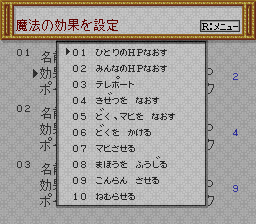
| No. | Effect | Japanese | Target | Points | Where a hero can cast it | Animation |
|---|---|---|---|---|---|---|
| 1 | Heal one | ひとりのHPなおす | One ally | HP restored, up to the maximum | Field and battle | | |
| 2 | Heal all | みんなのHPなおす | The whole party | HP restored to each | Field and battle | | |
| 3 | Teleport | テレポート | | Unused | Field only: to a town or dungeon entered before | | ||
| 4 | Revive | きぜつをなおす | One ally | Unused | Battle only: ends knocked out, not HP 0 | | |
| 5 | Cure | どく、マヒをなおす | One ally | Unused | Field and battle: ends poison and paralysis | | |
| 6 | Poison | どくをかける | One foe | Unused | Battle | Yes |
| 7 | Paralyse | マヒさせる | One foe | Unused | Battle | Yes |
| 8 | Seal magic | まほうをふうじる | One foe | Unused | Battle: the target can't cast | Yes |
| 9 | Confuse | こんらんさせる | One foe | Unused | Battle | Yes |
| 10 | Sleep | ねむらせる | One foe | Unused | Battle | Yes |
| 11 | Knock out | きぜつさせる | One foe | Unused | Battle | Yes |
| 12 | Attack up | こうげき力をあげる | One ally | Added to attack (at most 9,999) | Battle | | |
| 13 | Defence up | ぼうぎょ力をあげる | One ally | Added to defence | Battle | | |
| 14 | Speed up | すばやさをあげる | One ally | Added to speed | Battle | | |
| 15 | Attack down | こうげき力をさげる | One foe | Taken from attack (at least 1 left) | Battle | Yes |
| 16 | Defence down | ぼうぎょ力をさげる | One foe | Taken from defence | Battle | Yes |
| 17 | Speed down | すばやさをさげる | One foe | Taken from speed | Battle | Yes |
| 18 | Damage one | ひとりにダメージ | One foe | HP taken, exactly | Battle | Yes |
| 19 | Damage all | みんなにダメージ | Every foe | HP taken from each | Battle | Yes |
| 20 | Lift curse | のろいをとく | One ally | Unused | Field only: the cursed equipment is removed and lost | |
"Animation" marks the effects the sample gives one to: the hostile ones, eleven of them, the number the manual gives for the effects that take a graphic. The points are exact: there is no defence against a spell and no variance, so a damage-one spell of 31 points takes exactly 31 HP. Only an enemy can cast teleport in battle, and then it is gone (Enemies' magic). The animations themselves are in the catalogue. A hero's spell shows its animation on each target in turn (with several targets they flicker); an enemy's spells show none.
Enemies#
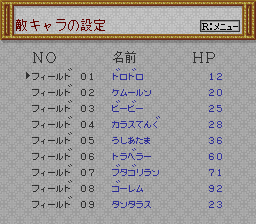
Enemy Settings 敵キャラの設定 holds 96 enemies in three groups of 32 Manual pp. 64–67:
| Group | Numbers | Fought | Escape |
|---|---|---|---|
| Field (フィールド) | 1–32 | At random on the field, where the enemy map puts them; each is a land or sea enemy, or both | By the odds |
| Dungeon (ダンジョン) | 1–32 | At random on the 128 maps, where the enemy map puts them | By the odds |
| Event (イベント) | 1–32 | Only through an event's battle command: bosses and set fights | Never |
Which enemies a field screen or a map screen can throw at the party, and how often, is set in Enemy Map Editing (Enemy maps). A random battle draws a group of up to four from those, as many as fit across the screen (Encounters).
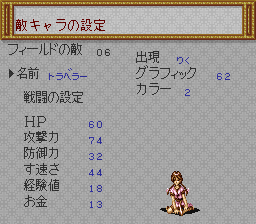 12345678910111213
- 1 Enemy number フィールドの敵 06 field enemies 01-32, then dungeon and event enemies 01-32
- 2 Name 名前 トラベラー up to 8 characters
- 3 Battle settings 戦闘の設定 opens the methods, its magic and the chest
- 4 HP HP 60 0-9999, as are all the stats
- 5 Attack 攻撃力 74 damage = (attack - defence) / 2
- 6 Defence 防御力 32 subtracted from the attacker's attack
- 7 Speed す速さ 44 turn order: everyone by speed, highest first
- 8 Experience 経験値 18 every living hero gets the whole total
- 9 Gold お金 13 gold for the kill
- 10 Appears 出現 りく field enemies: りく land, うみ sea, or both
- 11 Graphic グラフィック 62 one of 83 enemy graphics
- 12 Colour カラー 2 one of four colourings, 1-4
- 13 The enemy the chosen graphic in the chosen colour
| Field | Japanese | Values | In battle |
|---|---|---|---|
| Name | 名前 | 8 characters | | |
| Appears | 出現 | Land (りく), sea (うみ) or both; field enemies only | Which field battles it can join: on foot, the land enemies; aboard the sea vehicle, the sea enemies |
| Graphic | グラフィック | 1–83 | Its picture (the catalogue) |
| Colour | カラー | 1–4 | One of the graphic's four palettes |
| HP | | 0–9,999 | Full at the start of every battle | |
| Attack | 攻撃力 | 0–9,999 | Against the hero's defence |
| Defence | 防御力 | 0–9,999 | Against the hero's attack |
| Speed | すばやさ | 0–9,999 | Its place in the turn order, and the escape odds |
| Experience | 経験値 | 0–9,999 | Added to the battle's total when it is killed |
| Gold | お金 | 0–9,999 | Added to the battle's gold when it is killed |
Enemies have no MP and no luck. They cast their spells for nothing, as often as they choose them.
Battle settings#
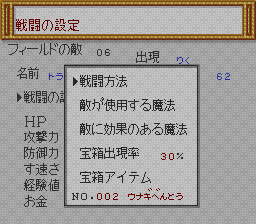 1234567
- 1 Battle settings 戦闘の設定 the enemy's behaviour in battle
- 2 Battle methods 戦闘方法 the actions it may take, several, one picked at random each turn; 14 to choose from
- 3 Magic it uses 敵が使用する魔法 spells it may cast, chosen from the 64
- 4 Magic that works on it 敵に効果のある魔法 the spells that take effect on it
- 5 Chest rate 宝箱出現率 30% the chance of a chest after the battle, plus the heroes' average luck / 100
- 6 Chest item 宝箱アイテム the item in the chest
- 7 The chosen item NO.002 ウナギべんとう item 002, an eel lunch box that restores HP
Battle settings 戦闘の設定 holds what the enemy does in a fight: its battle methods 戦闘方法, the magic it uses 敵が使用する魔法, the magic that works on it 敵に効果のある魔法, the chest rate 宝箱出現率 and the chest item 宝箱アイテム.
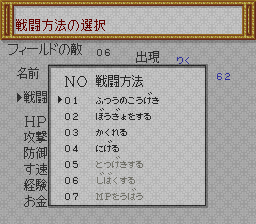
There are 14 battle methods. Methods 1–8 are things the enemy can choose to do on its turn; methods 9–14 change how it does them:
| No. | On screen | Method | What it does |
|---|---|---|---|
| 1 | ふつうのこうげき | Attack | Strikes a random hero: (attack − defence) ÷ 2 |
| 2 | ぼうぎょをする | Guard | Halves the physical damage it takes this round |
| 3 | かくれる | Hide | Can't be targeted; comes back out at 1 in 4 a turn |
| 4 | にげる | Flee | Leaves the battle: no experience, gold or chest from it |
| 5 | とつげきする | Charge | Strikes a random hero for attack − defence (not halved), then takes a counter-blow |
| 6 | じばくする | Self-destruct | Only at half its HP or less: every living hero takes half the enemy's HP, and the enemy dies |
| 7 | MPをうばう | Steal MP | A random hero loses a quarter of its MP (at least 1). The enemy gains nothing |
| 8 | なにもしない | Nothing | Passes the turn |
| 9 | いちどに2かいこうげき | Two actions | Every turn it chooses and acts twice |
| 10 | いきかえる | Comes back | Killed, it comes back to life at full HP at 1 in 4 a turn |
| 11 | まほうこうか2ばい | Double magic | Its spells' points are doubled (at most 9,999) |
| 12 | みかたをこうげきする | Attacks its own side | Its attacks and hostile spells go to its own side |
| 13 | つうこんのいちげきアップ | Critical up | Critical hits at 1 in 4 instead of 1 in 16 |
| 14 | こうげきを ミスする (not in the books) | Misses attacks | Each attack, and each target of each spell, fails at 1 in 2 |
How an enemy chooses: each turn it picks one option at equal odds from the methods 1–8 it has and the spells it uses. An enemy with Attack and three spells casts three turns in four on average; one with Attack alone always attacks; one with nothing ticked does nothing. Who it aims at is in How battles work.
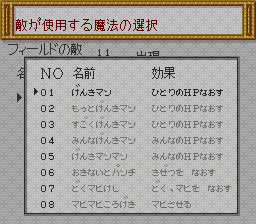
Magic it uses: any of the 64 spells. Doubled with method 11.
Magic that works on it: for each of the 64 spells, whether it affects this enemy. A spell not ticked does nothing to it, whatever it is: a fire spell, a sleep spell, a heal. Heroes have no such list, and every spell works on them. In the sample, about half the enemies have every spell ticked; the others are spared a few, its bosses among them.
Chest rate and chest item: the chance, 0–100 %, of a chest after the battle, and what is in it. Only the last enemy killed counts: if the party kills a rich enemy first and a poor one last, the poor one's chest decides (The chest).
Fan-made reference material, one of the Eschaton Games Tsukuru guides. Not affiliated with the publishers of the titles it covers.